April 22, 2006

Lombard does Garbo – sort of

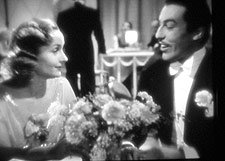
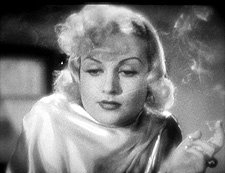
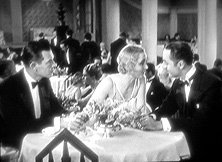
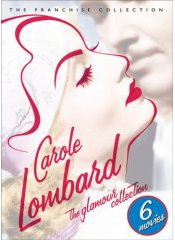
Slowly, I am making my way through Carole Lombard: The Glamour Collection. There’s just one movie left to watch as last night I took in the awkwardly named The Princess Comes Across (1936).

I have to assume the 1935 film Hands Across the Table had some success as The Princess Comes Across teams Lombard once again with Fred MacMurray. The 1935 film is a good movie (thus far the best of this six movie collection) and this attempt to recapture its successful elements works pretty well also, though not to quite the same degree.

It also does a few new things. It’s essentially a romantic comedy but it also blends in a murder mystery, so there are some suspense elements. These, however, aren’t particularly strong – the emphasis is on romance-comedy.

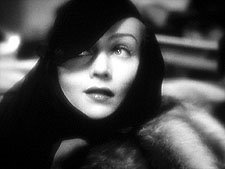
The film also seems to have some fun with having Carole Lombard do something of a send-up of Greta Garbo. Lombard plays a woman from Brooklyn, a struggling actress, who has scammed her way onto a cruise ship and into a movie by pretending to be a Swedish princess. When in her princess mode, Lombard puts on an accent and strikes an attitude that is pure Garbo. It’s very successful and also very funny.
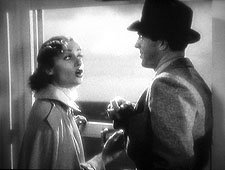
MacMurray, on the other hand, is basically playing the same character he does in Hands Across the Table (though with a different name). Here, he’s a musician – a concertina playing band leader. But he’s also a smart-alecky, young man “on the make,” so to speak. He’s very breezy, throws out one liners and, soon, is in love with the princess.

He eventually discovers, or at least suspects, there is something not quite right about “the princess” but doesn’t let on that he knows. As with the earlier teaming with Lombard, both actors play characters who are in love but keeping secrets from the other – each is trying to maintain the upper hand.
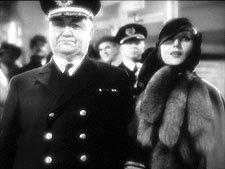
In this sense, it is pretty standard 30’s romantic-comedy material. But with films like this the success lies less in the originality of the script than in the execution. In this case, with Lombard and MacMurray making a good pairing, the execution is pretty darned good – though I think Hands Across the Table works a bit better.

The one criticism I would have with The Princess Comes Across would be with the murder mystery aspect. That element often seems to strike a wrong note in the context of the rest of the film. I don’t think it is so much that the murder element doesn’t belong as it isn’t handled terribly well.

But that’s a fairly small quibble. Overall, this is a pretty good example of a 30’s romantic comedy and worth a viewing. And if you like Carole Lombard you’re sure to get a kick out of her take on Greta Garbo.

The Princess Comes Across:
- Amazon.com (U.S.)
- Amazon.ca (Canada)

Tag: , , , , ,

April 17, 2006

Love Before Breakfast – awful, just awful

Although this is a structurally sound film, the end result is not and it is due to the characterizations, at least for me.

This is a Carole Lombard film but unlike Hands Across the Table, this film, Love Before Breakfast, is a mess. In the first half of the film we get Preston Foster as the love interest, Scott Miller. But he’s so obnoxious as the wealthy guy who has decided he wants Lombard’s Kay Colby character, you just want him to blow up or something. Good grief, he’s annoying.

In the film’s second half, his character Miller more or less gets his way and what we end up with is Lombard playing a twit – and now you want her to blow up or something.

In other words, the extremes they put the characters to in order to manage the storyline are ... well, too extreme. Neither is particularly likeable; both are actually quite annoying.

So while in a formal sense you can see how it probably should work in terms of execution it’s a disaster.

It’s a shame too, because some of the root elements are there. And certainly the actors are, at least as far as Lombard goes. But the role dissolves into such an idiot you just can’t get behind the story.

This is a good example of what does not work in romantic comedies.

Tag: , , , ,

April 15, 2006

Watching Visonti’s The Leopard

As it’s a fairly pricey three disc set, I’ve been holding off on getting the DVD of Lucino Visconti’s The Leopard (1963) from The Criterion Collection. But I found it this weekend at 20% off and I think that’s about as cheap as I’ll ever find it, so I finally picked it up.

So last night I watched it, the Italian version – not the dubbed American version which is also included, though from everything I’ve heard about that version I’m not sure why they bothered.

I think this is the first time I’ve seen it from start to finish. When I was younger, I saw it in bits and pieces on TV – both the Italian and American versions. It’s long and epic and elegiac. And it’s beautifully shot.

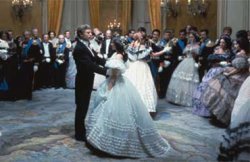
The film shows “… the tumultuous years of Italy’s Risorgimento – when the aristocracy lost its grip and the middle classes rose and formed a unified, democratic Italy.” It certainly does, but it does this through the eyes of Prince Don Fabrizio Salina (Burt Lancaster) and because it does the film has the elegiac quality I mentioned. The Prince is probably the only one who knows and understands what is happening. He realizes he is old now; his world has past so he sees the events that go on around him with somewhat tired, bemused eyes – tinged a bit with regret but accepting nonetheless.

Visually, Lancaster is perfect as the Prince. He has the stature and bearing, as well as the world-weariness necessary for the role. (Although Visconti wasn’t exactly thrilled to get Lancaster, “a cowboy.”)

As the world is changing around him, the Prince sees someone will have to take his place. With not a great deal to choose from, he focuses on his nephew Tancredi (Alain Delon) as the best bet. The Prince also sees Tancredi will need to make a marriage that will provide him a fortune (as the Prince’s estate will be divided among all his children). This, he determines, should be the beautiful Angelica Sedara (Claudia Cardinale), daughter of Don Calogero Sedara, mayor of the town of Donnafugata. This would be a good marriage for the Prince’s family as the mayor, something of an oaf, has managed to become wealthy through land.

The Prince, in other words, is trying to arrange his world (his family) for when he he is gone – and it won’t be the same world he has known.

And it’s this that is most fascinating about The Leopard. While the social change may be inevitable and necessary, something is also lost and we see what is being lost in some of the low comedy and the boorish manners of the classes that are rising. In the first part of the film where we see the violence of the rebellion, there is also a sense of comedy to it. The rebels win less because of their ability to defeat the soldiers they face than through sheer numbers and disorganization.

Perhaps Claudia Cardinale best captures the change Visconti wants to show. She’s stunningly beautiful and appears perfectly suited for the formality of the world she’s entering (the Prince’s aristocratic world of privilege). Later, we see her at the dining table chewing her bottom lip nervously. Later still, her elbow is on the table, her chin resting in her hand as she slumps over listening to Tancredi and others. While she has the look to capture everyone, she doesn’t have the social niceties.

The Leopard (Il Gattopardo):
- Amazon.com (U.S.)
- Amazon.ca (Canada)

Tag: , , , ,

April 11, 2006

Love and money – Hands Across the Table

I’ve just watched Hands Across the Table (1935), yet another of the six films in the Carole Lombard: The Glamour Collection and it is nothing less than fantastic. I loved it.

It’s a wonderful romantic comedy.

Unlike the previous two films where Lombard was really playing second fiddle to lead male actors (William Powell and Bing Crosby) this is clearly Carole’s film augmented by a great and spirited performance from a young Fred MacMurray.

Thematically and structurally the story is pretty conventional (though maybe not so conventional in 1935, but certainly in terms of today). A young woman who has grown up poor, scrimps to save as a manicurist, believes she absolutely must marry for money – love is nonsense, money is the only intelligent choice.

She meets a man she believes has money. This notion is quickly dissuaded as she learns that not only does he not have money but he’s just as she is – angling for a marriage that will pay the bills.

If you’re at all familiar with films you can guess how this plays out.

The script's originality is not the issue here, though. It’s a conventional plot. What makes this such a marvelous film are the performances and the cinematic execution, especially in 1935 terms. This film just moves. It totally engages and completely delights.

There are several great moments in it – most with between Carole Lombard and Fred MacMurray but also those with Ralph Bellamy (who again plays a nice guy who ends up losing but we feel okay with that – hmm).

I’m particularly thinking of the scenes with Lombard and the drunken MacMurray. And, later, the scenes between the same two the night before they are to go their separate ways and, finally, Carole’s crying jag in Bellamy’s room.

Ultimately, what I liked so much about this film has nothing to do with originality. It has everything to do with execution. There are fine supporting performances to buttress the great performances we get from the leads – Lombard, MacMurray and Bellamy. The pacing is crisp and the sets and lighting are excellent, particularly in some of the more serious scenes.

The film is also fun for some of the sexual aspects that get through … There’s a certain amount of suggestion and innuendo that, had the film been made a few years later, I don’t believe would have made it to the final cut.

I’ve watched three of the six films in the set Carole Lombard: The Glamour Collection and, thus far, while I’ve enjoyed them all, this is easily the best. If you like romantic comedies, or you like Carole Lombard or both, this is highly recommended.

Hands Across the Table:
- Amazon.com (U.S.)
- Amazon.ca (Canada)

Tag: , , , , ,

April 10, 2006

Watching The Last Samurai yet again

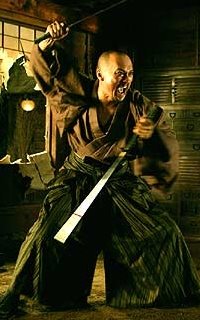
As well as I can remember, I’ve never posted about Edward Zwick’s The Last Samurai (2003). This surprises me because I like the movie so much. I’ve lost track of the number of times I’ve seen it.

I know that with all the media nonsense about Tom Cruise these days that the default response is to hate anything he’s involved with but, let’s be honest, for all his annoying media hoo-hah and some of those tedious action figure movies, he’s been involved in some great films and has given some great performances.

I’m not sure how he’s managed it, but manage it he has.

But The Last Samurai … it’s essentially an epic western, which may be why I like it so much. Now, by western I’m not referring to cowboys and shootouts and so on. I’m referring to the fact that this is essentially a romantic morality tale, which the best westerns almost always are. (And by romance I’m not referring to love stories but to a way of seeing and feeling about the situation and the characters and this also is informed by the moralistic aspect of the film.)

By morality I’m referring to the way a code of honour is in the background of everything the characters do or do not do. It’s implicit in some way in all their choices and in the way they feel about those choices and the situations they are in. Here, with this film, that code of honour is much more explicit – it is the Samurai’s code which, as it turns out, is very similar to the “the western code” that informed so many of the great Hollywood westerns.

Now you may wonder why the Tom Cruise character (Nathan Algren) is so prominent in the film when the “last samurai,” and the heart of the film, is Ken Watanabe’s character (Katsumoto). I think there are two reasons for this (ignoring the third, for the moment, which would be the marketing aspects of the Tom Cruise face and name).

First of all, Cruise’s Algren is us, the western audience. While the movie is set largely in Japan and it is about samurai it is not to be taken as a Japanese film. It is Japan seen through western eyes, in this case, Algren’s. So what he sees and how he interprets it is from the perspective of the west.

This leads to the second reason his character is significant. He provides the movie's major story arc. He begins in despair – no real sense of honour remaining to him, just cynicism and a kind of animalistic sense for survival. His journey to Japan becomes a spiritual one as he finds the honour feels he’s lost (and the west has lost) lives in the way the samurai conduct themselves, their code.

The film does not go for an easy (and unrealistic) happy ending, however (though it doesn’t leave us in despair either). While it’s suggested Algren may have gone on to a happier life, or at least one less troubled, the samurai are clearly through, falling ultimately to the mindless and amoral technology of the west.

The new displaces the old but, the film suggests, there is a spiritual vacuum at its heart … though perhaps not necessarily as the final gesture of the Japanese soldiers suggests a hunger for what the samurai represented.

In the end, what I most like about the film is that I find it compelling from beginning to end. Both Cruise and Watanabe are perfect in their performances and they are supported by actors who seem to be flawless in their roles.

It’s also visually riveting – both the action scenes (and their great representation of chaos) and the more subdued, character focused scenes.

As mentioned in one of the features on the DVD, some of the best scenes involve no dialogue at all – they are strictly visual, driven by great performances and cinematography.

I really cannot imagine someone not enjoying this film. I think it’s one of the best to come out in the last few years.

Note: The Last Samurai is currently available in standard DVD (widescreen and full screen editions) and will also be released on HD-DVD on April 18, 2006.

The Last Samurai:
- Amazon.com (U.S.)
- Amazon.ca (Canada)

Tags: , , , ,

April 8, 2006

Narnia – now here’s a good movie

There have been a number of over-hyped movies that have come to DVD recently and I’ve seen many of them. Frankly, almost all of them left me shrugging my shoulders and wondering what the fuss was about. Lots of cinematic hoo-hah and very little substance.

But tonight I watched Chronicles of Narnia: The Lion, the Witch and the Wardrobe. Yes, it’s rather a long title but the movie is excellent. Actually, it’s better than excellent. It’s a real movie – one with an actual story.

I suppose C. S. Lewis can be credited with that as he wrote the book. Much like The Lord of the Rings trilogy, the film succeeds to a large extent because of its source material and the way the filmmakers approach that material.

To be honest, I’ve never actually read the C.S. Lewis books (unlike Tolkien’s trilogy) so I’m just guessing here. But I can't see this kind of story coming out of the movie world unless it was based on something written in a previous era.

Anyway … I highly recommend this one. It beats the pants off of most contemporary movies and, of those contemporary movies that employ big budgets, special effects and so on, none are even close to The Chronicles of Narnia. Forget King Kong – this is the movie you should see.

Tags: , ,

April 7, 2006

We’re not making a good movie

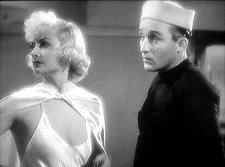
I’ve just watched the second movie from the set Carole Lombard: The Glamour Collection. It’s called We’re Not Dressing (1934) starring Bing Crosby and Carole Lombard.

This isn’t Carole Lombard’s film. As with Man of the World (which featured William Powell) this movie is about Bing Crosby, the male lead. Lombard is in a supporting role – a large supporting role, mind you, but supporting nonetheless.

And this is why the film leaves a great deal to be desired. It is a Crosby vehicle. It’s about Crosby the crooner and from the very opening, the guy is singing to beat the band. That he is singing isn’t the problem. The problem is that there is so much of it and that the songs, when you get down to it, are okay at best. Most sound like pale imitations of “Cheek to Cheek.”

The movie, therefore, is more than a little flat. However, there are some wonderful moments in it, most of them being the Lombard scenes. In fact, you really wish the emphasis had been switched and it had been a Lombard movie with Crosby playing second banana.

The Lombard scenes are pure Lombard. They have the sexiness and feistiness and humour you expect from Carole Lombard. She shines whenever she appears.

Then there are George Burns and Gracie Allen, who are screamingly funny. Though I’ve heard of their team for many years it is seldom I’ve had a chance to see them. While I assume this is just a taste of what they were together, they are just so funny.

And then there are Ethel Merman and Leon Errol. They, too, are fabulously funny, especially Errol as the drunken uncle.

I kept wishing Crosby would stop singing so we could get back to the interesting characters.

The Crosby hero character, by the way, has little development and little substance. It’s just a stereotype. Clearly, his job was simply to sing his way into the heroine’s heart, and the audiences too. That’s too bad. It’s not that he is poor in the role; it’s that there is nothing to it and, since it is the focus of the film, the movie suffers greatly.

But … for some of its sporadic better moments, We’re Not Dressing is worth a look.

April 6, 2006

Lombard and Powell – Man of the World

First of all, apologizes for anyone who is finding my pages annoying these days. I’ve tried out some ad things to see how they worked and what would happen. Some may remain; some may go. What I want to know is … can I generate any money from my various sites without annoying the hell out of people? If I can, that would be nice since I sink more than a few dollars into my Internet stuff. If I can offset it, I’d like to. But I don’t want to become the owner of sleazeball pages.

Anyway … the point is, I’m experimenting to see what I can do and what I can’t. It’ll all settle down soon, soon. Please be patient.

As for movies …

Tonight I watched the first of my Carole Lombard movies on from the Carole Lombard: The Glamour Collection set. Visually, it’s pretty good for movies this old though it would be nice if they had done some cleaning up. (I say that having only seen one film from the collection, so take my opinion with a grain of salt.) But for the price, the quality is pretty good. The set is two discs with six movies included. This means movies on both sides of the discs, something I don’t care for but, again, given the price I can live with it.

The first film I watched was Man of the World (1931). I knew nothing about this film so imagine my pleasure when I saw it starred William Powell. Yes, it was a film that featured the stars of my all-time favourite movie My Man Godfrey, Powell and Carole Lombard.

It’s no where near as good as that movie but Man of the World is pretty good, if a bit odd. The first half is comedic in the romantic-comedy set up tradition. Powell is a sophisticated ne’er-do-well, falls in love with the charming daughter (Lombard) of a wealthy twit, she falls in love with him … And using what has since become a formulaic idea, he must confess to her who he really is and … and this is where it takes a different tack from the usual.

Normally, he would attempt to explain himself but never get a chance to. In most movies there is a kind of coitis-interruptus when this happens. In this case, Powell does get to explain himself. That was a surprise. The film takes even stranger directions than what we’ve become accustomed to in that she accepts him despite his past (which, given he's confessed, we expect) but he is guilt ridden by the idea of his past and the notion of saddling her with it, so he torpedoes the relationship.

In other words, the comedic sensibility of the opening half of the movie shuffles off to Buffalo and the film takes a somber turn for its latter half.

Yes, it’s romantic and to an extent it works, but it is not the expected resolution of the storyline. It should also be said it has a younger William Powell playing a bit more seriously than we have come to expect from his later films. He’s good at this but the scenes, again in the latter half, are not balanced by lighter ones so there is a heaviness to the movie’s final half partly due to Powell’s character. He's just too glum.

Having said all that, I still found the film quite delightful. However, it is a bit confused, I think, in that it wants to tell both a serious story and a lighter romance at the same time and it just doesn’t work that way. You have to make a choice.

The movie is worth seeing however, especially if you’re a fan of Carole Lombard and William Powell. (This is one of Carole Lombard’s earliest films.) You can see the beginnings of what would later be a great team in My Man Godfrey.

Tag: , , , , ,

April 5, 2006

My movie backlog – Lombard, Dietrich, etc.

I’ve got movies coming out the wazoo these days. I managed to pick up some great films at Blockbuster of all places as “previously viewed” for $4.99 each, like: Marx Brothers A Night at the Opera and A Day at the Races, Stephen Fry’s Bright Young Things and Yimou Zhang’s (or Zhang Yimou, if you prefer) Raise the Red Lantern.

By the way … I highly recommend Bright Young Things. It’s a good film and includes a scene with Peter O’Toole that is hysterical.

I also had two Amazon orders arrive almost simultaneously. So both the 1956 and 1923 versions of Cecil B. DeMille’s The Ten Commandments are on deck. And also arriving (and both now viewed) are Donavan’s Reef (a John Wayne flick) and Heaven Knows, Mr. Alison (Robert Mitchum and Deborah Kerr, two favourites, directed by John Huston). Of the two, I’ve got to go with Heaven Knows, Mr. Alison as the better film – by quite a bit. But more about that in another post.

Also arriving – Carole Lombard: The Glamour Collection and Marlene Dietrich: The Glamour Collection. Taken together (the Lombard and Dietrich sets), that’s 11 more movies! The upside is that those films tend to be about 70 to 90 minutes long each – which makes them suitable for double features.

The point is, I’ve got a lot of stuff to watch. Sonewhere between 15 and 20 films. Whether I get to write about it all remains to be seen. But I’ll be watching movies while the rest of you are watching American Idol. Ha!

Tag: , , ,

April 1, 2006

Two movies, two big budgets, two duds - and Yes

"A story like mine should never be told."
- Memoirs of a Geisha -

You know, there's something to that. It seems to relate to a least two films I've seen this week. Though the issue may be less that the stories shouldn't be told so much as they shouldn't be told in certain ways.

I’ve watched a couple of this week’s big DVD releases – King Kong and Memoirs of a Geisha. In both cases – way too long.

And in both cases, I was bored.

And, in both cases, the problem is sort of the same – not enough emphasis on story, too much emphasis on how wonderful the world’s they were creating were. Yes, the pictures are interesting but images alone aren’t enough.

In the case of King Kong, I would have cut the first hour in half and, in the next two hours, taken a machete to the action scenes. They weren’t bad, they were just too much. And they got boring. I was getting up and doing dishes, laundry, anything because my mind was wandering.

Same thing with Memoirs of a Geisha (which was duller than King Kong). Pretty pictures but pretty pedestrian storytelling. And dull, dull, dull.

I also couldn’t figure out why it was in English. It would have made more sense in Japanese with sub-titles for those of us who don’t speak Japanese. It makes no sense, in 2006, to have a film set in Japan, with all Asian characters, in English – especially one concerning the story this one does. In fact, the movie overall is too Hollywood for its subject matter. (Where's Yasunari Kawabata when you need him?)

Nice story, but poorly executed. Pretty though. Unfortunately, pretty is interesting for about 15 minutes and this thing is over two hours long.

I also watched Sally Potter’s Yes this week, ten times better than those other two movies (Kong and Geisha). Though I wouldn’t say it’s a great film, unlike those other two, even with some failings it is 100 times more interesting and worthy of seeing a second time. (I’m still asking myself, “Yes, but what about the husband? What about the daughter?”)

While not meant as a criticism, I also wonder why Yes is written in verse. Why write it that way rather than the usual way (non-poetic). I suspect because we’re supposed to keep in mind that this is artifice, not life as it truly is (though that’s not quite true – yes, I contradict myself). We’re supposed to be aware that things are at least slightly heightened for the purposes of art – but again, why?

I think because we’re supposed to question it. And I’ve lots of questions.

Anyway … While none of these three films is an out of the park home run, Yes beats the pants off of King Kong and Memoirs of a Geisha. I was not bored for a single moment watching that one.

And, in the end, it simply isn't worth
your while to try and clean your life away.
You can't. For, everything you do or say
is there, forever. It leaves evidence.
In fact it's really only common sense;
there's no such thing as nothing, not at all.
It may be really very, very small
but it's still there. In fact I think I'd guess
that "no" does not exist. There's only "yes".

- Yes -

March 26, 2006

Week-end in Havana – very 1940s

While you couldn’t call it a great movie, I was surprised at how much fun was to be had with the musical film Week-end in Havana (1941).

For one thing, it just looks good. It’s technicolour and, from a 1940’s perspective, very exotic (it’s set in a Hollywood version of Havana, after all). But it also has four great performances - Cesar Romero, John Payne, Alice Faye and the always singular Carmen Miranda.

Romero, in particular, is wonderful. He’s dashing and he’s funny at the same time. As, in a different way, is John Payne. Alice Faye is your basic Hollywood female star, and she’s very good at it.

This is a very programmed movie, meaning its story is a Hollywood template. And yes, you know more or less how the story is going to go, but that’s fine. In fact, in many ways, that is the point of the movie. It tries to deliver what is expected of it. What makes it work is how well it does this and what it can do within those tight parameters to make it stand out.

Week-end in Havana may not be a movie for everyone; it may be just for people who like this kind of film: classic Hollywood, a musical, a standard story line. This is 1940’s escapism. But my, it is so much fun to watch! At least for me.

Notes:
- I love Cesar Romero's off-white linen suit when he dances with Alice Faye (the white shoes, not so much).

- Strangely, I found the comic romantic scene between Carmen Miranda and John Payne a tad erotic - perhaps it was Carmen's feistiness.

- There are a number of great innuendo moments in this film. John Payne opening the champagne is a good example.

- Carmen Miranda's outfits are wonderfully outrageous. I love them.
Week-end in Havana:
- Amazon.com (U.S.)
- Amazon.ca (Canada)

Tag: , , , , ,

March 21, 2006

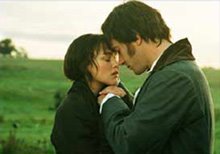
Pride & Prejudice – I loved it

I’m extremely annoyed with myself because I had written the beginnings of a piece on the film Pride & Prejudice and I can’t seem to find it now. So, starting from scratch …

I loved this film. But let me start where my first version started. With Jane Austen.

When you go to university and get your degree in English literature you end up reading a lot of books. That makes sense; it’s reasonable. However, it should be noted that many of these books, in fact (at least initially) are mind-numbingly dull. So it’s a hard slog.

This isn’t to say the books are without worth. They would not be on the curriculum if they were. But books are more than arranged words. They are ideas. They are culture. They are societies. And they are history.

So, when reading an older book, particularly one from the 17th, 18th or 19th centuries, you are dealing with attitudes, culture, syntax and many other things that are not your own. Thus, many older works are not as readily accessible as contemporary ones. It takes some time to acclimate to the author’s style and the world he or she is telling about.

Jane Austen’s Pride and Prejudice was the first novel I read while studying Enlish literature that I almost immediately was absorbed by. I couldn’t believe how easily it read. I couldn’t get over how much I liked it. Yes, the sentence structure and characters and story overall seemed a bit formal, yet it read so well. It was so engaging.

Why? There is a litany of reasons you could list off, beginning perhaps with wit, but I think the main reason is behaviour. Jane Austen has human behavior nailed down.

Now, finally getting to the film, what I most like about the movie Pride & Prejudice is how it articulates and shows human behavior. I don’t have Austen’s text memorized so I can’t compare the film and the book, but I’m pretty sure the movie takes numerous liberties with her story. But that’s okay. I think it remains true to its essence, how people behave.

More than anything else, I love how the film depicts women. I think a lot of this is communicated by camera work, editing and sound/dialogue. I noticed how the camera (using a steadi-cam) is often moving, moving, moving when we have the several sisters together. In a house full of women (Mr. Bennet excepted) it captures the constant activity of women, the several conversations that occur simultaneously, just as women seem to do when they are together. One is playing piano, two are chasing one another through the house, another is working on the table setting … all are doing something, yet all are interacting with the other women in the house. And all at the same time.

And Mr. Bennet stands back bemused and befuddled by it all, and also in love with all of it.

This is what I most love about this movie – the depiction of women.

I would add, too, that for someone (me) who pays more attention to story and structure and isn’t terribly observant when it comes to the visual aspects of films, I was also struck by how this film was shot. As I mentioned above, there is a great deal of camera movement, usually in informal scenes, especially when the women are relaxed, being themselves with one another. But the film is also quite static and consciously framed in the more formal scenes. In fact, there is a certain Sergio Leone quality to the way some scenes are staged for the framing. Or so it seems to me.

In some films, this could be a problem. It would be simply too much cinematic artifice for a convincing film. But I think in this case, with the world it is showing us, it works perfectly and it’s definitely one of the aspects of the movie I most enjoyed.

I also loved all of the performances. Although a few have disagreed, I think Keira Knightly is perfect as Elizabeth Bennet, as are Donald Sutherland as Mr. Bennet and Rosamund Pike as Jane. It is, however, a bit misleading to mention those three since everyone in the film is bang on.

Finally … to be honest, the film works because it begins with such extraordinary material. Jane Austen has to be credited with that. It is simply a great story, well told. The movie itself is a success because of how it presents that story, and that lies in the excellence of the screenplay, direction and performances.

This film is about as close to a perfect love story as they get.

Tag: , , , ,

March 20, 2006

Great lines – Out of the Past

I finally watched Out of the Past tonight (starring Robert Mitchum and Jane Greer). It’s a great film noir piece and there are a lot of great lines in it like, “And then I saw her, coming out of the sun …”

Yes, great lines. But my favourite line has to be:

“He couldn’t find a prayer in the Bible.”

Now that was funny. Of course, this is noir and it’s not a comedy – still, that was a funny line.

As movies go, Out of the Past is great. Unfortunately, it’s late so I can’t ramble on about it. But take my word for it, this is good and highly recommended.

Tag: , , ,

March 19, 2006

Lombard, Dietrich ... and John Ford?

Looking at some of the discs due to be released in the coming weeks and months, it seems clear companies like Warner Bros. are determined to keep me from paying off my mortgage. I mention Warner in particular because of some of their box sets and their planned HD-DVDs (due in April). Have a look at what's coming:

March 21:
- The Busby Berkeley Collection (Footlight Parade / Gold Diggers of 1933 / Dames / Gold Diggers of 1935 / 42nd Street)
- Stalag 17 (Special Collector's Edition)
- The Ten Commandments (50th Anniversary Edition)
April 4:
- Carole Lombard: The Glamour Collection (Hands Across the Table/ Love Before Breakfast/ Man of the World/ The Princess Comes Across/ True Confession/ We're Not Dressing)
- Marlene Dietrich: The Glamour Collection (Morocco/ Blonde Venus/ The Devil Is a Woman/ Flame of New Orleans/ Golden Earrings)
- Mae West: The Glamour Collection (Go West Young Man/ Goin' To Town/ I'm No Angel/ My Little Chickadee/ Night After Night)
We're Not Dressing)
- Films of Faith Collection (The Nun's Story / The Shoes of the Fisherman / The Miracle of Our Lady of Fatima)
June 6:

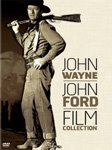
The John Wayne-John Ford Collection - This a 10 disc set that features 8 movies from the team of John Ford and John Wayne, including ...
- The Searchers: Ultimate Collector’s Edition
- Stagecoach: Two Disc Special Edition
Although both of these have previously been available on DVD, it looks like now they will be getting the kind of disc treament they should have. I'm hoping these will look great - in the case of Stagecoach it will be restored and remastered from the best available film elements. But the collection will also include three films previously unavailable on DVD:
- Fort Apache (1948)
- The Long Voyage Home (1940)
- Wings of Eagles (1957)
From what I understand, many of the movies in The John Wayne-John Ford Collection will be available individually, however not all of them will be. You read more about this planned release and take a look at some of the artwork by a quick visit to DVD Times.

Tag: , , , , , , , , ,

March 18, 2006

The Talk of the Town (1942)

This is something I posted a while back that I decided to post again after seeing a few other mentions of it online. I rated it as a 3 out of 5.)

This is a movie that mixes romantic-comedy and thriller, though the emphasis would be more on the former. But because The Talk of the Town mixes the two, it falters a bit. But not a lot.

It begins smartly by establishing itself with quick, mostly non-dialogue scenes. A factory burns, a man dies in the fire. Arson is the cause, and Leopold Dilg is arrested (Cary Grant with an unlikely name). It's a rush to justice; Dilg’s guilt is a foregone conclusion.

The factory owner has the town stirred up against Dilg and everyone is calling for an execution. Dilg, with no seeming choice, escapes prison.

He flees to a house where Nora (“the prettiest girl in town”) is preparing for a tenant. She hides Dilg in the attic. The tenant, the very straight-laced and famous law professor Michael Lightcap (Ronald Coleman) arrives early and Nora is in a fix – what to do with Dilg?

Up to the moment the scene shifts to the house and Nora (Jean Arthur, hair done up and shaded a light brunette here), the movie is very dramatic. While it’s quick and very well done, the shots of a brooding Cary Grant somehow don’t work.

In fact, through the whole film Grant somehow doesn’t seem quite right when playing the brooding part.

This may be less his performance than baggage brought from other roles (pre-conceptions of the Grant character), but it doesn’t seem quite right. He’s best when he finally steps out of the shadows and starts engaging both Nora and the Professor in banter.

The story of the film is how the three main characters work to get to the truth of things and prove Dilg’s innocence. The real story, though, is how Nora and Leopold loosen up the Professor, and the conflict Nora has with whom she loves. She loves both men – who will she end up with?

In fact, this movie is really Jean Arthur’s movie, and she is wonderful in it, even if she is playing the Jean Arthur character – pretty self-assured till she’s in a fix, then a bit scrambled.

The best performance, though, may come from Ronald Coleman. His tight-bummed Professor, and the arc he follows to loosen up, is excellent. He plays serious perfectly, while also playing innocence without any false notes.

Overall, The Talk of the Town is a very good romantic comedy, though somewhat overlong. It works best when focused on its comedic aspects and seems to lose itself when veering off for a moment or two to be serious.

I think director George Stevens may have been trying to comment to some extent on mob justice, and the rule of law.

However, as in his movie Shane (and generally any film that has a message), all this does is bog the movie down with earnestness. It becomes an appeal to the head rather than the heart.

Films tend to operate best viscerally.

The Talk of the Town (1942):
- Amazon.com (U.S.)
- Amazon.ca (Canada)

Tag: , , ,

March 14, 2006

In A Lonely Place and the tragic flaw

Although I've put this assessment of In A Lonely Place online before, elsewhere, I like the movie so much I'm posting it here. And I'm thinking I'm may watch it again tonight.

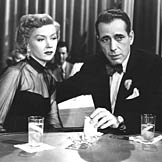
Watching In a Lonely Place, I couldn't help recalling all those English Lit classes about tragedy and the hero with a tragic flaw. This is a film noir with Humphrey Bogart playing such a character and the result is a great, if heartbreaking, movie.

As someone else commented (somewhere on the Web - I don't remember where), it's a little eyebrow raising to find out the set was a replica of a place where director Nicholas Ray lived and the film is called In a Lonely Place.

This is a movie about loneliness. As with many noir films, the hero (or anti-hero) is an outsider. He's isolated from everyone around him. Here, however, he has a chance to alleviate that loneliness, finding love with a woman he feels understands him (Gloria Grahame).

Humphrey Bogart plays Dixon Steele, a Hollywood screenwriter with a less than stellar career. He's cynical about the business he's in, dislikes its commercialism, and goes about with a chip on his shoulder. He also has a volatile temper. The anger he carries around with him is generally repressed but always on the verge of boiling over. Often, it does.

He's given a novel to read to see what he can do about turning it into a script. But rather than read the novel, he gets a starry-eyed hatcheck girl to come over to his place and tell him the story (since she has read it).

Later, after leaving, the girl is found murdered. Steele becomes a suspect, the lead detective's prime candidate.

Steele has an alibi, however. It comes by way of Laurel Grey (Grahame), his neighbour across the courtyard. Steele and Grey develop a relationship and are soon in love. This love frees Dixon from his demons, at least for a time, and he starts riding a creative wave, writing the script he's been asked for but, at the same time, turning it from a trashy novel into something considerably better.

But the investigation of the murder haunts Dixon and Laurel. His temper soon resurfaces and she sees this part of him. Soon, she (and we, the audience) start to wonder if Steele is innocent or not. His temper certainly makes it seem possible he committed the crime.

Doubt and distrust begin to eat away at Dixon and Laurel's relationship and it soon starts to spiral downward.

Bogart is tremendous in this movie and you could make a good case for this being his best performance. While you can empathize with him to an extent, and want the relationship of Dixon and Laurel to work, you can't help also disliking him because of his anger and suspicions. With a personality such as his, with his emotional problems, it's easy to see how if the relationship were to work it would soon become characterized by domestic violence.

Gloria Grahame is also perfect. It's difficult to imagine anyone else in this role. You can see the love and fear battling within her. In noir movies, she's the ideal femme fatale. (See The Big Heat, for example.)

The movie also has a perfect ending. It has something of a twist to it but it doesn't seem forced or imposed. Rather, it seems inevitable.

While In a Lonely Place begins with the appearance of a potboiler murder story (which I gather the book it came from was), the murder here is just an excuse to tell the the real story - the relationship between Dixon and Laurel, and how Dixon's flaw affects and determines its end.

Note:

There is also some great black and white cinematography here. Roger Deakins has mentioned this as one of the movies that influenced the shooting of the Coen brothers The Man Who Wasn't There.

In A Lonely Place:
- Amazon.com (U.S.)
- Amazon.ca (Canada)

Tag: , , , , , ,

March 12, 2006

I regurgitate my thoughts on Kiss Me Deadly

A couple of years ago I watched Kiss Me Deadly for the first time. While I know the movie is well thought of by quite a few people, I have to be honest: I hated it. Here's a portion of the review I wrote back when I saw it:
While the tonal darkness of the film is appropropriate, the lack of balance with anything off-setting makes the overall movie feel like a lengthy root canal procedure. It's painful and unrelenting. The ending, while fitting, leaves you wondering about the point of the whole thing. The film begins in darkness and ends in deeper darkness and while this may make it almost the quinessential noir film it also reveals the weakness of the noir approach, at least when taken to excess. As with consuming too much of any good thing, you're left feeling queasy.

The film makes for an interesting study though. As one of the latter films of the initial wave of noir films (roughly mid 40's to mid 50's), it shows the style at its furthest reaches of development. Its strengths have now become weaknesses. The darkness that informed the style in its beginnings and created a tone for the telling of certain stories has now become the dominent feature of the stories. It's far too excessive here.

Noir, I think, is essentially romance turned on its head. It's about disappointment and its mood is melancholy. In Kiss Me Deadly, the undertone of romantic loss is gone and is replaced by self-indulgent cynicism (the ultimate opposite end of romance). It ends now not in disappointment but horrific "I told you so" disaster.

While I suppose it's as legitimate viewpoint as any, as a film experience it's an unpleasant one.

Recommended for noir freaks only. Definitely NOT recommended for anyone suffering from depression.
You know, I'd like to give the movie another chance. But I had such a negative response to it the first time, I find it difficult to bring myself to watch it again. But maybe one day.

(By the way ... there's an interesting discussion about in this thread, Kiss Me Deadly debate.)

Kiss Me Deadly:
- Amazon.com (U.S.)
- Amazon.ca (Canada)

Tag: , , , , ,

March 10, 2006

Missing jade necklaces: Murder, My Sweet

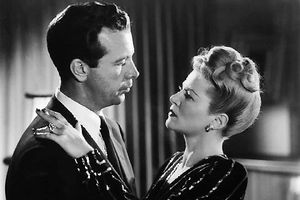
Needing to get back to some older movies after a pretty lengthy drought, tonight I watched one that had been in my movies on-deck circle for some time, 1944’s Murder, My Sweet directed by Edward Dmytryk and written by John Paxton based on the Raymond Chandler novel.

First of all – it’s good. Not great, but a good noir film and it captures most of the noir elements. It stars Dick Powell in the Philip Marlowe role and, if the scribblings on the packaging are to be believed, Powell was Chandler’s “favorite screen Marlowe.”

Not mine, however. And that is not to say I didn’t like him in the role. But I came away with a great desire to go back and watch Humphrey Bogart as Marlowe in The Big Sleep (also as Sam Spade in The Maltese Falcon).

Again, this is no knock on Murder, My Sweet but, good as it is, it’s not an out of the park home run. (What’s with the baseball metaphors?)

The movie has a lot of what you would expect from a movie of this kind: a lot of uncertainty as characters appear to be good, then bad, then good again, then bad. Marlowe seems to think one thing then it’s shown he was only pretending, although a later scene shows he actually does think and feel that way. In other words, it twists quite a bit and in many cases the twists are arbitrary for the sake of being a twist and to sustain the mood. But they don’t make a lot of sense.

But that’s okay, it’s what we expect and want from a movie like this.

While this isn’t the best noir film of all time, it’s definitely a good example of the genre and an entertaining movie.

Murder, My Sweet:
- Amazon.com (U.S.)
- Amazon.ca (Canada)

Tag: , , , , ,

March 9, 2006

Water – Deepa Mehta’s very human film

I wasn’t sure what to expect from Deepa Mehta’s film Water. My impression going into it was it might be a little too earnest for my taste. But I’m happy to say that isn’t the case.

I watched it tonight and really liked it. As mentioned in one of the featurettes on the DVD, the way it is shot, the look, counterbalances to a degree the somewhat despairing aspect of the situation so you are not overwhelmed by it and continue to be carried along by the story. It’s as visually engaging as it is engaging in terms of the story, though in a different way.

(That probably makes no sense unless you’ve seen it – it simply means, it’s well lit, coloured, and shot … and the story is compelling.)

And I was happy that the theme, and how it is explored, is more than simply about women in history, some pretty awful conditions and a dreadul situation. Rather, it uses the situation of widows in India as a starting place to tell a much more encompassing human story.

I’m trying to explain this without explaining the story and probably haven’t done a good job. (I'm trying to avoid a recounting of the plot - something I generally find pointless in movie reviews and, in some cases, revealing of the movie in a way you don't want.) I’m probably sounding more muddled than anything though I think what I’ve tapped out here makes a bit more sense once you’ve seen the movie.

The point of this post, however, is that this is a good film and well worth seeing. The story captures you and carries you along. It is definitely a film to be recommended as it is wonderfully shot and constructed (both in terms of story and visually).

On the two disc DVD edition that I have, just released in Canada (I don’t think it’s available in the United States yet), there are two versions. One in Hindi with subtitles and another “alternate version” shot in English – not previously released. I have only seen the Hindi version so far so I’ve no idea what the English one is like.

But I would say this about the Hindi version. Unlike some subtitled movies, this film is very visual so following the subtitles is not that difficult. In fact, at times I forgot to read them as so much of the story is conveyed visually. (As opposed to some films where a great deal is in the dialogue and you can’t really watch the film – you’re too busy reading subtitles to follow the story.) So I think you’re probably better off watching the Hindi version. It is, after all, set in India, 1938.

Water - Special Edition (2 discs):
- Amazon.ca (Canada)

Tags: , , ,

March 6, 2006

Clueless Hollywood - the Oscar scolding

This morning following the Oscar broadcast I found it interesting to listen to what people were talking about.Two things seemed to dominate - the Academy's message about DVDs and Jon Stewart as host. Stewart seems to have received universal approval.

The same can't be said for the DVD message. What were they thinking? It seemed a very patronizing and ill-informed approach to a genuine problem. They seem to equate DVDs with piracy, whereas I thought they made quite a bit of money on DVD sales.

My guess is that Hollywood will go down the same road as the music industry: not understanding, accepting and adapting to changing technology and audiences but rather fighting it tooth and nail and thereby driving more and more people to pirated materials, if only because the industry is so pig-headed.

They need to also consider that, in the light of reduced revenues, while piracy may be a problem it was not movie audiences that chose to make a movie like The Dukes of Hazzard.

Tags: , , , ,