February 27, 2006

Brilliant, disturbing – The Weather Man

“Always fast food. Fast food. Things that people would rather throw out than finish. It's easy, it tastes all right, but it doesn't really provide you any nourishment. I'm fast food.”

I don’t know how to describe, or recommend, the move The Weather Manwithout scaring people away from it. I’m convinced that when I make my list of best DVDs for 2006 this will be on it simply on the merits of the film. It’s easily the best thing I’ve seen in quite a long time.

But it’s also incredibly depressing.

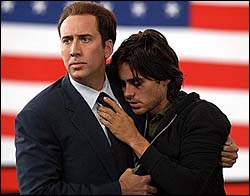
Normally, I dislike movies that are as down as this but somehow, and I’m not sure how, director Gore Verbinski and writer Steve Conrad (not to mention Nicolas Cage in what may be his best performance) have made this an utterly compelling film.

I know Dave Spritz (Cage’s character). I sometimes fear I am Dave Spritz. As Roger Ebert points out, while this is a comedy of sorts (a satire), it’s really a tragedy. That is the arc. However, part of what makes this movie so interesting is the way the script plays with that.

In terms of how the final scenes are presented, such as the style, it feels like a kind of happy ending, almost a Hollywood ending. But once you think about what the ending is, what it means … well, then you see what Ebert means about the story being about a hero who falls from “a low height.”

It is a fall, despite the tone of the ending (which is part of the satirical element).

I suppose what I most like about the film is that it is a story of a man who is average at best (or, as the character Spritz himself puts it, “I’m fast food”) struggling in our contemporary world, one that is predicated on him being exactly that – average at best, fast food.

I should mention the other brilliant performance in the film, which is Michael Caine as Spritz’s father Robert. Caine manages to get most of the best lines and shares the movie's best scene with Cage.

And despite the humour in the film (which is really not that funny as it’s undercut, fittingly I think, by the music which continually reminds us of what we’re seeing), it is Caine’s character who really gets at what the movie’s informing theme is when he refers to “this shit life.”

The movie is about coming to terms with that, rather a dubious accomplishment as the movie suggests.

Tag: , , , , , ,

February 12, 2006

What I’ve been watching

My posts seems to be very light on content and not terribly frequent these days. So it goes when life insists you pay the rent. But …

Earlier in the week I picked up (and watched) Breakfast at Tiffany’s – Anniversary Edition. While I’ve always liked the movie, it does have a few problems (like Mickey Rooney’s Japanese guy – not a great idea).

But you have to love Audrey Hepburn in this. And the quality of this disc seems pretty good so, given the price, it’s well worth picking this up.

I also watched A Very Long Engagement, which I personally like a lot more than Amelie, also directed by Jean-Pierre Jeunet and starring Audrey Tautou. Unfortunately, I’m not sure I can articulate why I liked it so much. I’ll try to figure it out.

Let’s see … what else? Well, Hustle & Flow was pretty darned good. I also watched The Gift (from 2000), which I liked quite a bit (I like most things with Cate Blanchett).

Also watched Educating Rita (1983) – a pretty film good though not as good as I remember. (I saw it way back when it came out and absolutely loved it. Time has taken some of the glow off for me, though.)

Finally … I’ve watched Cameron Crowe’s Elizabethtown – actually, I watched it twice. Although hugely flawed, I really liked it a lot – probably because it’s a type of movie I’m drawn to and I like Kirsten Dunst. But I do think the movie overcomes its flaws and works to a degree.

While it appears I've not been watching older movies recently (and I haven't), this should change soon. In the "on-deck circle"? Chaplin's City Lights (1931). And Ford's Young Mr. Lincoln (1939). So I'm excited.

Tag: , , ,

January 28, 2006

I'm still watching older movies

It appears from my last few posts that all I'm watching is new movies. But actually, that's not quite the case. It's true I go in phases where I go for a period focused on older films then a new phase of newer ones, but the last few posts are a bit misleading. They appear to be all recent releases. But ...

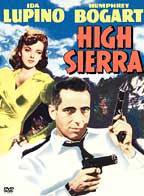
One of the best of the discs I've watched recently was High Sierra (1940) ... that's the one that kind of got Humphrey Bogart going and it's absolutely wonderful. I don't know if I'll get around to writing about it, but just so you know (if you don't already), it's a bit of a noir piece.

I'm also in the process of working my way through Sam Peckinpah's the Legendary Westerns, a collection of four of his films of which I've so far watched Ride the High Country and The Ballad of Cable Hogue.

Anyway ... the point is, I am watching a good variety of new and old, I just haven't had the time to post about them.

But I'll try! I'll try!

Tags: , , ,

January 22, 2006

My top DVDs of last year revised slightly

A while back I posted My Top Ten DVDs of 2005 … but I was rushed when I did it and hadn’t really given it the thought I should have. And there was one glaring omission. And that, of course, was Serenity.

How could I have missed that?

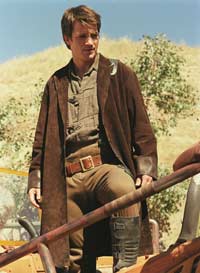
It’s easily my favourite film of last year. In fact, I spent Christmas watching Serenity and, afterwards, watching the Firefly series.

(Yes, I was compelled to pick up that DVD after seing the movie.)

What is it about Serenity that makes it so good? Well, like a really good TV series it yanks you into its characters and makes you want to know what’s happening to them. Also, despite being science fiction of sorts, it’s really a western – with all the clichés and romanticism and mythology that that implies.

It has action but, unlike some of the more idiotic action films, it knows that it’s most riveting element is its characters and so, even during action sequences, the film pauses for a line or two of dialogue that reinforces who the characters are and what their motivations are. It’s not just guys banging each other over the head and some razzle dazzle cinematic tricks.

More than anything else, though, it is just fun to watch. I’ve seen it three times now and I’m surprised that I’m not yet tired of it. I will likely watch it again soon.

I think it wins hands down as my favourite film of last year. I think it's the science fiction film I was always hoping the various Star Trek films might be.

Tag: , ,

January 19, 2006

Lord of War - the lecture

Quickly ... watched Lord of War last night and I'm still trying to determine what I thought of it. Actually, I do know ... but I want to watch it again as my mood may have influenced my perception.

But here are a few thoughts ... the first thing that struck me was how dark the DVD is. I think they went overboard in the transfer with the contrast or whatever the tech way to describe it is called. Scenes are supposed to be dark but this seemed excessive to me. Some shots were silhouettes, but so were some shots that weren't supposed to be. At least, that's how it struck me.

I wished they had packaged the two disc set in something other than lame-ass cardboard.

The movie ... I was a bit put off because, as I've mentioned in other places, I'm not a big fan of films that use voice over narration. And this film is almost all voice over narration. So to a large degree my sense was of a story being told as opposed to being shown.

The film is very earnest about it's subject matter (the sale of guns). And while I am sympathetic to the point of view, it felt like listening to an impassioned speech. It felt like being lectured to.

As someone on another site describe it (can't remember which one), it's a bit like an extended public service announcement.

I'll give the film another chance, as I said. But I think generally I was disappointed. I believe some of the good reviews the film received were based on being told what we want to hear, rather than seeing a good story on film.

Tag: , ,

January 11, 2006

The Constant Gardener - good but some reservations

I orginally posted this as a comment on DVD Town (to their review of The Constant Gardener). But I thought I'd put it up here ... for what it's worth:

I just watched the film and I'm a little ... uncertain what I think. I liked the it, i'm just not sure how much I liked it.

I've read the novel and wish I hadn't - I'd prefer to see a film without preconceptions. Still, I suspect having read the novel doesn't affect the viewing all that much. The visual style, however, does.

While I had no problem in the second half of the film, once it had decided to settle on Ralph Fiennes' character, in the first half I found the documentary style (for lack of a better word) simply compounded what was already a confusing exposition.

So I'm not so sure I give this a big stylistic thumbs up. I think it might have played better with a more conventional style. I think in the first half there is simply too much information to convey for this kind of approach. I think the style, as a style, is fine but requires a more simple story to work effectively.

As you've mentioned, both in the movie and the book, the relationship is easily the most compelling element of the story. The drug company thing ... well, that's the usual movie stuff. But the relationship - now that was compelling.

But I'll have to watch it again before I decide.

Tag: , ,

January 8, 2006

My Top Ten DVDs of 2005

Yes, I'm a little slow getting this up but better late than never.

As mentioned in previous years, more than anything else this reflects what I watched - it's as much gut based as it is critical. Maybe more so. I've watched all of these several times since getting them simply because I liked them. In some cases it's based primarily on the quality of the film though the quality of the DVD and it's overall packaging is often a factor too.

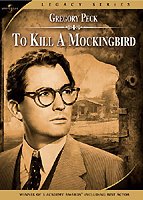
Which is why I think to To Kill A Mockingbird may have been the best DVD release of 2005. Quite apart from the merits of the film, the DVD and its packaging were superb as well. (On the other hand, The Miracle of Morgan's Creek is based strictly on the film - the DVD is a pretty good transfer but nothing to write home about in terms of the features or packaging, which are all but non-existent.) And in some cases, I put collections in as opposed to single movies because - well, they were great collections.

Again, in no particular order, my top ten DVDs of 2005:

- Bringing Up Baby (1938)
- Finding Neverland (2004)
- Errol Flynn: The Signature Collection (1935 - 1941)
- A Love Song for Bobby Long (2004)
- The Life Aquatic with Steve Zissou (2004)
- Million Dollar Baby (2004)
- The Complete Thin Man Collection (1934 - 1947)
- Crash (2004)
- To Kill A Mockingbird - Special Edition (Legacy Series) (1962)
- The Miracle of Morgan's Creek (1944)

Tag: , , , ,

January 6, 2006

Still here and watching movies

Yes, I've been M.I.A. for quite some time, though I've been watching movies. A LOT of movies.

For instance, tonight I watched The Skeleton Key, a movie that was okay - not great - until it got to the end where it sucked in a very major way. Predictable ending - the kind where some idiot decides he or she will be clever and do a Twilight Zone kind of end. That means (bit of a spoiler here) that the good guys come out badly and the bad guys win.

It's the kind of ending you dream up when you're 16 and think you're brilliant. I found it a very disappointing end to a movie that, up to that point, had been a parade of cliches fairly well handled.

By the way ... who was the genius who hired a great actor like John Hurt to play a part where he does nothing but groan and look pathetic? A freaking monkey could have played that. If you're going to hire good actors, give them something to do for heaven's sake.

The movie isn't as bad as I make it sound. But the more I think about it the more annoyed I get at its wasted potential.

On the other hand ... should you want to see a good movie, one of the many films I've seen recently is This Gun For Hire (1942) with Veronica Lake (looking fabulous), Robert Preston and Alan Ladd as the somewhat tortured Raven, a somewhat troubled killer. A great noir piece.

I've seen many other films recently, and hope to get to them eventually. For example, Two for the Road (1967) was pretty good (Audrey Hepburn and Albert Finney), as was Leave Her To Heaven (1950), in a bit of a soap opera-ish way (Gene Tierney, Cornel Wilde and Jeanne Crain).

And my favourite over the holiday period, the TV series Firefly and the subsequent movie Serenity. They were fabulous!

Tag: , , , ,

November 26, 2005

Lost at sea - Hitchocock's Lifeboat

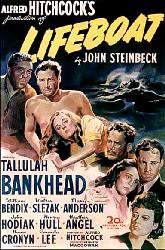
I haven't been feeling well the last few days and thus haven't had an inclination to do much of anything, but ... I did manage to watch a film or two, including Alfred Hitchcock's Lifeboat (1944).

It was pretty good. As with most Hitchcock, he sets himself a challenge - in this case, shooting an entire movie within the confines of a lifeboat. From the opening shot of Tallulah Bankhead in her fur coat, with her camera sitting in the boat, right to the end, everything goes on in the boat.

You would think the film would get claustrophopic, but it doesn't. In fact, the scenes move quite quickly, and compellingly.

The film works partly because of the script (a story by John Steinbeck, screenplay by Jo Swerling). Relationships form, shift and develop through the movie. And it's set on the Atlantic during World War II (when it was also shot), so part of the drama comes from the fact that one of the passengers on the lifeboat is the captain of the German boat that sank the liner the rest of the passengers had been on.

In a way, it's a standard dramatic situation - take a disparate group of people and throw them together, here in a tightly enclosed space none of them can flee.

In a way, Hitchcock has made an entire film using a single set, much as he did with Rope though his approach is very different.

Regardless of what he does, the end result is a very entertaining movie.

Tag: , , , , ,

November 22, 2005

King Kong on deck

I can't say I'm overly excited about Peter Jackson's remake of King Kong - but that may change once it's out. As a general rule, I don't like remakes.

I am excited, however, about the Amazon package that arrived today with my King Kong Collection. This includes the special edition two disc set of the original King Kong (1933), the sequel Son of Kong, and Mighty Joe Young (1949). Also arriving in the Amazon box was a completely unrelated movie, Operation Petticoat (1959), which starred Cary Grant and Tony Curtis.

Jackson's King Kong may be the exception - a good remake. But until I see it and can judge, I'm more than happy to have the original. There's a certain charm to those black and white movies.

And really, there is no remaking Fay Wray, the girl from Cardston, Alberta.

Tag: , , , , ,

November 20, 2005

Hitchcock's Dial M for Murder quite slow

I see most movies by myself - perhaps because I watch so many, and so many during the week. But seeing movies with others, especially with people who like movies but are not aficionados, definitely is insightful.

After dinner last night, three of us sat down to watch Alfred Hitchcock's Dial M for Murder (1954).

Well, Liz fell asleep. Mind you, she was pretty whipped. Still, tired or not, someone falling asleep, especially early in a film, is not a good sign.

As we watched, I felt it dragged quite a bit, at least in the first half, due to all the tedious exposition - especially the scene where Ray Milland goes on with no apparent end essentially establishing the set up for the second half of the film. That's the scene where he explains to Anthony Dawson, who is being blackmailed into killing Grace Kelly, the scheme.

Gord, during all of this, commented on how bad the script was. I think he was responding to how extremely long the scene is, and how it was all dialogue. Sure, people moved around, there was some camera movement and a few cuts, but you can see how it is based on a play and that means people just talking, explaining. Hitchcock does try to make it visual but still, it is all dialogue. For an audience of today, the scene is quite deadly.

It's a weakness of the murder mystery - they inevitably have to establish story elements - characters and plot points - which usually means exposition. I find this in most of the old Columbo mysteries from TV. The first 20 or 30 minutes are boring because that is where they establish the crime and the characters. It isn't till Columbo shows up that things get interesting.

So it is in Dial M for Murder. It isn't engaging until the murder attempt is made, almost halfway through the film.

In the end, Dial M is worth seeing - there are some good elements. But it's also dated somewhat and, partly due to genre and partly due to its being based on a play, it is tedious for a large part of the film.

Still, watching Grace Kelly is, as always, delightful.

Tag: , , , , ,

November 17, 2005

Another of my recurring Cary Grant phases

I seem to be going through one of my recurring Cary Grant phases. I finished reading Cary Grant by Marc Eliot, and it was certainly interesting. (I made a brief post about on my other blog, Crazy Ass Planet.)

Of course, since I was reading about Grant, I had to watch (or rewatch) some of his movies. That meant The Philadelphia Story, The Awful Truth, North by Northwest and Brining Up Baby. But it also meant picking up a few of his other movies, ones I either hadn't seen or didn't remember.

So I also watched People Will Talk (1951) with Jeanne Crain and directed by Joseph L. Mankiewicz. Not a bad movie, but not great either. It's a little too earnest and Cary Grant is just a little too ... posed? There's very little range in his character. He's just a handsome good guy.

The other film I watched was The Bachelor and the Bobby-Soxer with Myrna Loy and Shirley Temple, directed by Irving Reis. I liked this one much more, though once again it's far from great. But, despite a pretty silly storyline, it's quite funny - largely because Grant plays comedy so well. And it is well-directed in a functional way. Grant seems much more comfortable and assured in this film than in People Willl Talk and I think it's because he was much more comfortable playing comedy, poking fun at himself, than in drama (unless he was being directed by Hitchcock).

Speaking of whom, the next on my list is Suspicion. I haven't seen that one for a while.

Tag: , , ,

November 13, 2005

For your viewing pleasure, Gina Lollobrigida

I don't know why, but I'm getting a lot people dropping off here looking for Gina Lollobrigida. I, too, am very fond of Gina.

I just don't know why people are looking for her here.

Actually, I do. Some time back I discovered, while searching for something else, a Gina Lollobrigida link came up - very high in the listing of results. I thought that was odd, posted about it, and used a Gina image in the post.

Now I'm one of the top, if not the top result when you search for Gina Lollobrigida images on Google.

Searchers must be very disappointed. This is not the place to be looking for Gina Lollobrigida information or images. It's just a blog about movies by a guy who likes Gina Lollobrigida, amongst many other actors. Ah well!

Tag: , ,

October 30, 2005

The Dude abides

I watched the Collector's Edition version of the The Big Lebowski and while I still feel the same way about the film, I have to say the intro they add to this DVD edition is incredibly funny. Especially if you waste a lot of time in the world of films and DVDs. As for the movie itself, the review I wrote quite a while ago still holds. It goes like this:

It's taken me quite a while to get around to seeing The Big Lebowski, but I finally have. (I seem to be on a Coen brothers thing this week.) My gut response? It's kind of boring largely, I think, because it's more a pastiche of scenes than a coherent whole.

This is deliberate, part of the movie's style. But for me, it works against it. It's one of those ideas that is better in thought than in practice.

In talking about it on the DVD's featurette, the Coens refer to this aspect when they discuss it in terms of a Raymond Chandler story, like The Big Sleep. I can see what they mean when they say this, but I just don't think it works.

Part of the problem seems to be that they've used this "confusing plot" idea as an excuse to try interesting visuals. While those visuals certainly are cool, you can't help wondering what the hell they have to do with anything. Just as songs disrupt the narrative flow in some musicals, so these visuals disrupt the flow in The Big Lebowski.

As usual with the Coen brothers, the story idea is very engaging and quirky. Jeff Bridges is The Dude, Jeff Lebowski, an unemployed doper who spends most of his time in his bathrobe doing dope, drinking White Russians and bowling.

One day he comes home and encounters two dimwitted gangster types, someone's "muscle," who demand money they say is owed to their boss. They rough up The Dude, threaten him and urinate on his carpet. Unfortunately, they have have confused him with another Jeff Lebowski, The Big Lebowski.

Thus do The Dude's adventures begin as he tries to get his carpet replaced by the other Lebowski.

Explaining the plot is pointless. Let's simply say The Dude encounters a rich, handicapped old man who wants him as a bag man because his young, promiscuous wife (who appears in porn films) has been kidnapped. The Dude meets pornographers, German nihilists and assorted other characters along the way.

He's aided by some friends, most notably by Walter (John Goodman) a Vietnam veteran with issues.

There are a host of funny, clever scenes in the film. But as mentioned, nothing hangs together very well. The movie looks great but often loses its pacing for the sake of cleverness, either in terms of getting an interesting looking visual or, in some cases, a characterization that works against it.

For example, Bridges' character is generally stoned or otherwise unable to articulate what he is wants to say. While it's appropriate for the character, the characterization slows the movie, clogs it. It's an idea (this kind of man in this kind of situation) that likely looks great on paper but, on film, doesn't quite click.

I suppose this all points to a larger problem, the lack of a narrative arc. The characters, by and large, are the same people at the end as they were at the beginning. So it doesn't ever go anywhere.

In the end, while there is no denying there have been funny moments, The Big Lebowski isn't satisfying. It has the feel of a young person showing off how clever he can be. There is a lot of style but not a great deal of substance.

I found it more frustrating than anything else though while watching it I also had the sense it was probably a film the Coens had get out of their system in order to move on. In movies that followed The Big Lebowski the same cleverness still appears but, in those films, it serves the movies they make rather than itself.

Tag: , ,

October 27, 2005

Yes, I watched Titanic again

Well, Titanic is out now in a 3-disc DVD "Special Collector's Edition," so I felt obligated. But I'm not objecting.

All the things the film's detractors list about why they don't like it are, I think, why it is such a good movie. Maybe not great, but very, very good. Yes, it's sentimental, romantic and very much a film of cinematic artifice, but that's what makes it so good. (Remember, those same things can be said, and should be said, of Casablanca.)

The film's popularity speaks to its merit. The real question is, what is it about movies like this that resonates with audiences?

Tag: , ,

October 22, 2005

Recent viewings: Garbo, John Wayne, Batman

I've seen a lot of different movies in the last few weeks but I haven't had time to scribble much about them. For instance, I picked up Garbo - The Signature Collection a while ago. That's the one with something like twelve movies (this includes three silent films from the late 1920's.)

Most of them are pretty good. I especially like Ninotchka (directed by Ernst Lubitsch, 1939). Very funny and I like the way the movie kind of uses the Garbo image (silent, aloof) as a part of the primary comedy. Garbo is great in it by the way.

Anna Christie (1931) ... well, I didn't like that one so much. In fact, I stopped watching after about 40 minutes because it was painful. This was her first "talkie." In fact, I think that's how they promoted it: "Garbo Talks!" Good grief, does she ever. That's all anyone does in this thing - long, long scenes of people sitting around talking. Anyway ... not the best film in the collection.

Camille (1936), on the other hand ... I really liked that one. Sentimental, yes. Romantic, yes. But a really good movie, none the less. And Garbo is extremely fetching in this one.

Other than Garbo, I watched John Wayne's Hondo (1953) a few days ago. It was released as a Special Collector's Edition at the same time as McLintock! - see the earlier post. Both of these films, by the way, were at a great price - $12.00 each when I picked them up. Of the two, I think my sentimental favourite has to be McLintock! but, honestly, Hondo is a much better film. As someone else mentioned, it has some similarities to Shane, another 1953 film.

Wayne is quintessentially John Wayne here with his North American machismo and all, and this film is one of the few movies I've actually seen that had the old Hollywood western cowboys and Indians thing going on (though, for the period, the First Nations people are portrayed with more sympathy than you might expect). Overall, it's a good western. (Of course, if you don't like westerns this is probably not your cup of tea.)

And let me mention one other movie ... Batman Begins (2005). Yes, it's very good. Of all the Batman movies I've seen, it's easily the best and definitely one of the best of the very popular glut of comic book movies that have been released. As usual with these kinds of movies, it works so well because they concentrate on character and story. But this movie reminds me a lot of the first Spiderman movie (though it's much better than that film).

The first half of the film is great. The second half, good but not great. The reason? Once he becomes Batman and the bad guys enter into things and the heroics start, it loses me (as did the first Spiderman). In other words, the man becoming the hero is far more interesting than the hero as the hero.

However, in this case, while Batman Begins loses some steam in the second half it doesn't lose a lot of it (unlike the first Spiderman).

Tag: , , , , , ,

October 16, 2005

McLintock! - Wayne and O'Hara at odds

I watched McLintock! (1963) last night. It’s not the greatest movie in the John Wayne canon, but you know, I’ve always liked it.

From what I’ve seen online, it doesn’t rate that high with many people, but then it’s not the most western of westerns. It’s essentially a comedy – one that is sort of a John Wayne version of Shakespeare’s Taming of the Shrew.

The movie sort of works off and on. There are about three big set pieces (like the mud fight and the inevitable confrontation between John Wayne and Maureen O’Hara). They work pretty well, but some of what goes on in between drags.

Still, I remember seeing this when I was young and loving it. I always like Wayne and O’Hara and while this is a far cry from The Quiet Man, it’s a fun film to watch. At least for me.

It’s a bit like Hatari! (another movie whose title ends in an exclamation mark). The story isn’t terribly important. Like a favourite TV show, you like it because of the characters – in this case, the usual Wayne and O-Hara characters. They’re fun to watch. You can’t help but like them.

Interesting how much brawling goes on in Wayne films. (By the way, while not a great movie, I'd definitely watch McLintock! before watching that other recent DVD release, The High and the Mighty.)

Tag: , , ,

October 15, 2005

The western - Costner's Open Range

I saw a reference to Open Range over on Purgatorian and it reminded me of how much I like the movie. Back when I reviewed it, I gave it four stars out of five. I may watch it again tonight - seems to me in retrospect I was a bit stingy with that assessment. Here's what I wrote back then:

Everytime someone makes a western numerous people comment that the western is dead. We're to take this as a film given. Personally, I'm sick to death of hearing this. If the form is dead, why do so many people still like them?

With Kevin Costner's Open Range, the comments I see over and over are something to the effect, "The western is dead but this is a really good movie." Huh?

I think there is a belief the western is kaput partly because there is a superficial understanding of what the western is. Some commentators confuse the presence of cowboy hats, horses and guns with what constitutes a western. A western, however, is a mythic morality tale where, quite often, there are cowboy hats, horses and guns.

But there are westerns set in outer space (like many Star Trek episodes) and westerns set on African safaris (like Hatari!). Some are set against backdrops of war (like Tears of the Sun).

If westerns seem "dead" it is only that we appear to be in a period of cultural fog where many of us have become so cynical we've abandoned any attempt to think morally. But thematically, despite Pulp Fiction and its knockoffs, western morality tales remain popular because they continue to address something we struggle with.

Open Range articulates this struggle well. While it may not be the greatest western ever made, it's a very good one and captures the essence of the western theme, often by reiterations of standard western scenes.

A pair of free grazers (Robert Duvall and Kevin Costner) are driving their cattle over the open range. But the open range of the American west is increasingly less open as land is fenced off by ranchers who are claiming it. The west is filling up; the last frontier is fading.

They come across a rancher who is particularly intent on getting rid of free grazers. He runs a town, keeping everyone under his dictatorial and greedy thumb. In the end, there is a showdown (in the best western tradition).

It sounds conventional because it is, but this is what the best westerns do. They don't stand out because of their innovation but because of how well they articulate the core western myths.

Films like these get at the essential paradox of America, "the land of the free." The more people seek the wide open spaces of America, the more people move into them to be free, the less free America becomes. In westerns, the most free people are also the most lonely. Their loneliness can only be alleviated by joining a community but this also means they are less free. Freedom is conditioned by the presence of others.

We also see, as in Open Range, a desire for law and order. The more people there are, the more constrained our freedom is. The question becomes, who will impose those constraints? The community, with shared values, or an individual who is more powerful than we are as individuals?

As Open Range plays out, the free grazers played by Duvall and Costner recognize the freedom they had is disappearing. Now, they have to make a choice. Knuckle under to the demands of the wealthy rancher, or become the instruments of the community's law and order?

Westerns also seem to be about maturing - growing up, to be blunt. Both as a country and as individuals. The freedom enjoyed in youth fades over time because it becomes increasingly isolated and lonely. At some point, it has to be put aside for some agreed upon constraints in order to become part of the group.

Open Range captures all this in a film that beautifully evokes the best aspects of the genre. Unlike other recent movies (like The Quick and the Dead), it doesn't appear to be interested in commenting on westerns in a modern, deconstructionist kind of way. It aspires to be a western and only a western. It keeps things simple, and this is also a key to the best films of this kind. They aren't about movies; they are about myths.

Tag: , , , ,

October 10, 2005

The Frank Oz comedies

I've always liked the comedies of Frank Oz. In fact, I would say that of the films I watch repeatedly, Frank Oz comedies are among the ones I most watch over and over. In a sense, they are a kind of cinematic comfort food. I always enjoy them and I always feel good after having watched them.

His comedies are a bit deceptive. They seem too nice (whatever that means). They seem perhaps too slick, or too something, because they have a pleasant Hollywood gloss to them, which gives them a feeling of unreality.

But that's really why they work the way they do. They aren't realistic and they aren't intended to be. They're movies about interesting, and funny, characters in absurd situations.

What I like most about his comedies, however, is that they are funny without being mean-spirited, as many comedies tend to be. It isn't the humour of a misanthrope but rather the humour of someone who finds life and people to be wonderful, but also wonderfully ridiculous.

Still, there is a certain (if minimal) element of darkness, even anger in them, but it is kept in abeyance. It’s never allowed to overwhelm the films; it simply serves as a root element from which to spring and inform the comedy. (An example would be In & Out, with intolerance at its core, or the satire of The Stepford Wives – not the best Oz film but certainly better than some gave it credit for.)

Ultimately, Frank Oz comedies are delightful confections that seem to laugh at us while loving us, and loving us especially for those things that make Oz laugh.

Comedies directed by Frank Oz:

- The Stepford Wives (2004)
- Bowfinger (1999)
- In & Out (1997)
- What About Bob? (1991)
- Dirty Rotten Scoundrels (1988)


(Of the above, I think my favourite would have to be Dirty Rotten Scoundrels, which I've watched so many times I've lost count.)

Tag: , ,

October 2, 2005

The Hours - I watch it yet again

The Hours - Nicole Kidman as Virginia WoolfI loved The Hours. I gave it five stars out of five. And I watched it again on Thursday so I thought I'd post the review I did of it a while ago (with one minor correction):

I don't know if it's necessary to have studied English literature, or to be familiar with Virginia Woolf and her works, but it certainly helps when watching the movie The Hours. I think someone unfamiliar would still enjoy the film but whether it's as accessible, I don't know.

It's especially helpful (I think) to have read Woolf's Mrs. Dalloway since the film is, in some ways, an improvisation from the story.

The movie is wonderfully, and complexly, structured and this is one of the great appeals of the film. As it progresses, you begin to see how the various elements relate. In a sense, it is something of a mystery (though not in terms of genre). You get hints and clues as the film unfolds.

The movie is three stories, related and interwoven. There is the Virginia Woolf story (Nicole Kidman) which focuses on her life in suburban Richmond where she has been taken because of her mental difficulties (probably bipolar depression). Here, she begins writing her novel, Mrs. Dalloway.

Then there is the story of Mrs. Dalloway (Meryl Streep), not the one from the novel but a present day Mrs. Dalloway who reflects the character from the book.

I'm not sure this is actually her name, it may simply be the name she has been given by her friend and former lover, the poet played by Ed Harris (who has AIDS and is dying). This is a woman whose busy social activities (giving parties, beaming smiles) hide the emptiness and pain in her life.

Finally, there is the early 1950's suburban housewife played by Julienne Moore. She is a woman who seems always on the verge of screaming as she covers her unhappiness and tries to meet the expectations of a wife of that period. While not stated overtly, there is the implication that her real problem is that she is lesbian at a time when that was simply not an option. It is why she doesn't fit in this world however much she tries.

It's difficult to describe much more of the film without giving away its secrets. The movie has a bit of a reputation as being depressing but, while it is thematically dark (with meditations on suicide and mental anguish), it is really the very opposite of this.

This is articulated late in the film when Virginia Woolf is asked by her husband why a character in her novel must die.

Her answer states the theme of the film.

For me, one of the great pleasures of the film is seeing how the pieces connect as it plays out. The stories all interrelate and watching the film is like a voyage of discovery.

It's also an ensemble piece flush with great performances throughout. The three lead performances, Kidman, Streep and Moore are all exceptional and each in a distinct way.

I wish I had seen this film earlier than I did. It came out on DVD back in the summer of 2003. Had I seen it, it would have been on my list of Top DVDs of 2003. (I may yet add it, despite being after the fact.)

Speaking of the disc, the image is pristine and the sound is great, especially with the score by Phillip Glass.

As for the features, this is one of the better discs for those. These aren't fluff features; there is some meat to them, including director Stephen Daldry discussing the film and a fairly good background documentary on Virginia Woolf.

Tag: ,