March 19, 2006

Lombard, Dietrich ... and John Ford?

Looking at some of the discs due to be released in the coming weeks and months, it seems clear companies like Warner Bros. are determined to keep me from paying off my mortgage. I mention Warner in particular because of some of their box sets and their planned HD-DVDs (due in April). Have a look at what's coming:

March 21:
- The Busby Berkeley Collection (Footlight Parade / Gold Diggers of 1933 / Dames / Gold Diggers of 1935 / 42nd Street)
- Stalag 17 (Special Collector's Edition)
- The Ten Commandments (50th Anniversary Edition)
April 4:
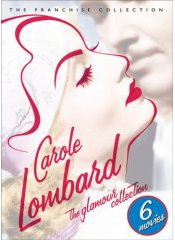
- Carole Lombard: The Glamour Collection (Hands Across the Table/ Love Before Breakfast/ Man of the World/ The Princess Comes Across/ True Confession/ We're Not Dressing)
- Marlene Dietrich: The Glamour Collection (Morocco/ Blonde Venus/ The Devil Is a Woman/ Flame of New Orleans/ Golden Earrings)
- Mae West: The Glamour Collection (Go West Young Man/ Goin' To Town/ I'm No Angel/ My Little Chickadee/ Night After Night)
We're Not Dressing)
- Films of Faith Collection (The Nun's Story / The Shoes of the Fisherman / The Miracle of Our Lady of Fatima)
June 6:

The John Wayne-John Ford Collection - This a 10 disc set that features 8 movies from the team of John Ford and John Wayne, including ...
- The Searchers: Ultimate Collector’s Edition
- Stagecoach: Two Disc Special Edition
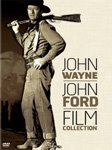
Although both of these have previously been available on DVD, it looks like now they will be getting the kind of disc treament they should have. I'm hoping these will look great - in the case of Stagecoach it will be restored and remastered from the best available film elements. But the collection will also include three films previously unavailable on DVD:
- Fort Apache (1948)
- The Long Voyage Home (1940)
- Wings of Eagles (1957)
From what I understand, many of the movies in The John Wayne-John Ford Collection will be available individually, however not all of them will be. You read more about this planned release and take a look at some of the artwork by a quick visit to DVD Times.

Tag: , , , , , , , , ,

March 18, 2006

The Talk of the Town (1942)

This is something I posted a while back that I decided to post again after seeing a few other mentions of it online. I rated it as a 3 out of 5.)

This is a movie that mixes romantic-comedy and thriller, though the emphasis would be more on the former. But because The Talk of the Town mixes the two, it falters a bit. But not a lot.

It begins smartly by establishing itself with quick, mostly non-dialogue scenes. A factory burns, a man dies in the fire. Arson is the cause, and Leopold Dilg is arrested (Cary Grant with an unlikely name). It's a rush to justice; Dilg’s guilt is a foregone conclusion.

The factory owner has the town stirred up against Dilg and everyone is calling for an execution. Dilg, with no seeming choice, escapes prison.

He flees to a house where Nora (“the prettiest girl in town”) is preparing for a tenant. She hides Dilg in the attic. The tenant, the very straight-laced and famous law professor Michael Lightcap (Ronald Coleman) arrives early and Nora is in a fix – what to do with Dilg?

Up to the moment the scene shifts to the house and Nora (Jean Arthur, hair done up and shaded a light brunette here), the movie is very dramatic. While it’s quick and very well done, the shots of a brooding Cary Grant somehow don’t work.

In fact, through the whole film Grant somehow doesn’t seem quite right when playing the brooding part.

This may be less his performance than baggage brought from other roles (pre-conceptions of the Grant character), but it doesn’t seem quite right. He’s best when he finally steps out of the shadows and starts engaging both Nora and the Professor in banter.

The story of the film is how the three main characters work to get to the truth of things and prove Dilg’s innocence. The real story, though, is how Nora and Leopold loosen up the Professor, and the conflict Nora has with whom she loves. She loves both men – who will she end up with?

In fact, this movie is really Jean Arthur’s movie, and she is wonderful in it, even if she is playing the Jean Arthur character – pretty self-assured till she’s in a fix, then a bit scrambled.

The best performance, though, may come from Ronald Coleman. His tight-bummed Professor, and the arc he follows to loosen up, is excellent. He plays serious perfectly, while also playing innocence without any false notes.

Overall, The Talk of the Town is a very good romantic comedy, though somewhat overlong. It works best when focused on its comedic aspects and seems to lose itself when veering off for a moment or two to be serious.

I think director George Stevens may have been trying to comment to some extent on mob justice, and the rule of law.

However, as in his movie Shane (and generally any film that has a message), all this does is bog the movie down with earnestness. It becomes an appeal to the head rather than the heart.

Films tend to operate best viscerally.

The Talk of the Town (1942):
- Amazon.com (U.S.)
- Amazon.ca (Canada)

Tag: , , ,

March 14, 2006

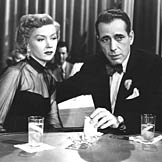
In A Lonely Place and the tragic flaw

Although I've put this assessment of In A Lonely Place online before, elsewhere, I like the movie so much I'm posting it here. And I'm thinking I'm may watch it again tonight.

Watching In a Lonely Place, I couldn't help recalling all those English Lit classes about tragedy and the hero with a tragic flaw. This is a film noir with Humphrey Bogart playing such a character and the result is a great, if heartbreaking, movie.

As someone else commented (somewhere on the Web - I don't remember where), it's a little eyebrow raising to find out the set was a replica of a place where director Nicholas Ray lived and the film is called In a Lonely Place.

This is a movie about loneliness. As with many noir films, the hero (or anti-hero) is an outsider. He's isolated from everyone around him. Here, however, he has a chance to alleviate that loneliness, finding love with a woman he feels understands him (Gloria Grahame).

Humphrey Bogart plays Dixon Steele, a Hollywood screenwriter with a less than stellar career. He's cynical about the business he's in, dislikes its commercialism, and goes about with a chip on his shoulder. He also has a volatile temper. The anger he carries around with him is generally repressed but always on the verge of boiling over. Often, it does.

He's given a novel to read to see what he can do about turning it into a script. But rather than read the novel, he gets a starry-eyed hatcheck girl to come over to his place and tell him the story (since she has read it).

Later, after leaving, the girl is found murdered. Steele becomes a suspect, the lead detective's prime candidate.

Steele has an alibi, however. It comes by way of Laurel Grey (Grahame), his neighbour across the courtyard. Steele and Grey develop a relationship and are soon in love. This love frees Dixon from his demons, at least for a time, and he starts riding a creative wave, writing the script he's been asked for but, at the same time, turning it from a trashy novel into something considerably better.

But the investigation of the murder haunts Dixon and Laurel. His temper soon resurfaces and she sees this part of him. Soon, she (and we, the audience) start to wonder if Steele is innocent or not. His temper certainly makes it seem possible he committed the crime.

Doubt and distrust begin to eat away at Dixon and Laurel's relationship and it soon starts to spiral downward.

Bogart is tremendous in this movie and you could make a good case for this being his best performance. While you can empathize with him to an extent, and want the relationship of Dixon and Laurel to work, you can't help also disliking him because of his anger and suspicions. With a personality such as his, with his emotional problems, it's easy to see how if the relationship were to work it would soon become characterized by domestic violence.

Gloria Grahame is also perfect. It's difficult to imagine anyone else in this role. You can see the love and fear battling within her. In noir movies, she's the ideal femme fatale. (See The Big Heat, for example.)

The movie also has a perfect ending. It has something of a twist to it but it doesn't seem forced or imposed. Rather, it seems inevitable.

While In a Lonely Place begins with the appearance of a potboiler murder story (which I gather the book it came from was), the murder here is just an excuse to tell the the real story - the relationship between Dixon and Laurel, and how Dixon's flaw affects and determines its end.

Note:

There is also some great black and white cinematography here. Roger Deakins has mentioned this as one of the movies that influenced the shooting of the Coen brothers The Man Who Wasn't There.

In A Lonely Place:
- Amazon.com (U.S.)
- Amazon.ca (Canada)

Tag: , , , , , ,

March 12, 2006

I regurgitate my thoughts on Kiss Me Deadly

A couple of years ago I watched Kiss Me Deadly for the first time. While I know the movie is well thought of by quite a few people, I have to be honest: I hated it. Here's a portion of the review I wrote back when I saw it:
While the tonal darkness of the film is appropropriate, the lack of balance with anything off-setting makes the overall movie feel like a lengthy root canal procedure. It's painful and unrelenting. The ending, while fitting, leaves you wondering about the point of the whole thing. The film begins in darkness and ends in deeper darkness and while this may make it almost the quinessential noir film it also reveals the weakness of the noir approach, at least when taken to excess. As with consuming too much of any good thing, you're left feeling queasy.

The film makes for an interesting study though. As one of the latter films of the initial wave of noir films (roughly mid 40's to mid 50's), it shows the style at its furthest reaches of development. Its strengths have now become weaknesses. The darkness that informed the style in its beginnings and created a tone for the telling of certain stories has now become the dominent feature of the stories. It's far too excessive here.

Noir, I think, is essentially romance turned on its head. It's about disappointment and its mood is melancholy. In Kiss Me Deadly, the undertone of romantic loss is gone and is replaced by self-indulgent cynicism (the ultimate opposite end of romance). It ends now not in disappointment but horrific "I told you so" disaster.

While I suppose it's as legitimate viewpoint as any, as a film experience it's an unpleasant one.

Recommended for noir freaks only. Definitely NOT recommended for anyone suffering from depression.
You know, I'd like to give the movie another chance. But I had such a negative response to it the first time, I find it difficult to bring myself to watch it again. But maybe one day.

(By the way ... there's an interesting discussion about in this thread, Kiss Me Deadly debate.)

Kiss Me Deadly:
- Amazon.com (U.S.)
- Amazon.ca (Canada)

Tag: , , , , ,

March 10, 2006

Missing jade necklaces: Murder, My Sweet

Needing to get back to some older movies after a pretty lengthy drought, tonight I watched one that had been in my movies on-deck circle for some time, 1944’s Murder, My Sweet directed by Edward Dmytryk and written by John Paxton based on the Raymond Chandler novel.

First of all – it’s good. Not great, but a good noir film and it captures most of the noir elements. It stars Dick Powell in the Philip Marlowe role and, if the scribblings on the packaging are to be believed, Powell was Chandler’s “favorite screen Marlowe.”

Not mine, however. And that is not to say I didn’t like him in the role. But I came away with a great desire to go back and watch Humphrey Bogart as Marlowe in The Big Sleep (also as Sam Spade in The Maltese Falcon).

Again, this is no knock on Murder, My Sweet but, good as it is, it’s not an out of the park home run. (What’s with the baseball metaphors?)

The movie has a lot of what you would expect from a movie of this kind: a lot of uncertainty as characters appear to be good, then bad, then good again, then bad. Marlowe seems to think one thing then it’s shown he was only pretending, although a later scene shows he actually does think and feel that way. In other words, it twists quite a bit and in many cases the twists are arbitrary for the sake of being a twist and to sustain the mood. But they don’t make a lot of sense.

But that’s okay, it’s what we expect and want from a movie like this.

While this isn’t the best noir film of all time, it’s definitely a good example of the genre and an entertaining movie.

Murder, My Sweet:
- Amazon.com (U.S.)
- Amazon.ca (Canada)

Tag: , , , , ,

March 9, 2006

Water – Deepa Mehta’s very human film

I wasn’t sure what to expect from Deepa Mehta’s film Water. My impression going into it was it might be a little too earnest for my taste. But I’m happy to say that isn’t the case.

I watched it tonight and really liked it. As mentioned in one of the featurettes on the DVD, the way it is shot, the look, counterbalances to a degree the somewhat despairing aspect of the situation so you are not overwhelmed by it and continue to be carried along by the story. It’s as visually engaging as it is engaging in terms of the story, though in a different way.

(That probably makes no sense unless you’ve seen it – it simply means, it’s well lit, coloured, and shot … and the story is compelling.)

And I was happy that the theme, and how it is explored, is more than simply about women in history, some pretty awful conditions and a dreadul situation. Rather, it uses the situation of widows in India as a starting place to tell a much more encompassing human story.

I’m trying to explain this without explaining the story and probably haven’t done a good job. (I'm trying to avoid a recounting of the plot - something I generally find pointless in movie reviews and, in some cases, revealing of the movie in a way you don't want.) I’m probably sounding more muddled than anything though I think what I’ve tapped out here makes a bit more sense once you’ve seen the movie.

The point of this post, however, is that this is a good film and well worth seeing. The story captures you and carries you along. It is definitely a film to be recommended as it is wonderfully shot and constructed (both in terms of story and visually).

On the two disc DVD edition that I have, just released in Canada (I don’t think it’s available in the United States yet), there are two versions. One in Hindi with subtitles and another “alternate version” shot in English – not previously released. I have only seen the Hindi version so far so I’ve no idea what the English one is like.

But I would say this about the Hindi version. Unlike some subtitled movies, this film is very visual so following the subtitles is not that difficult. In fact, at times I forgot to read them as so much of the story is conveyed visually. (As opposed to some films where a great deal is in the dialogue and you can’t really watch the film – you’re too busy reading subtitles to follow the story.) So I think you’re probably better off watching the Hindi version. It is, after all, set in India, 1938.

Water - Special Edition (2 discs):
- Amazon.ca (Canada)

Tags: , , ,

March 6, 2006

Clueless Hollywood - the Oscar scolding

This morning following the Oscar broadcast I found it interesting to listen to what people were talking about.Two things seemed to dominate - the Academy's message about DVDs and Jon Stewart as host. Stewart seems to have received universal approval.

The same can't be said for the DVD message. What were they thinking? It seemed a very patronizing and ill-informed approach to a genuine problem. They seem to equate DVDs with piracy, whereas I thought they made quite a bit of money on DVD sales.

My guess is that Hollywood will go down the same road as the music industry: not understanding, accepting and adapting to changing technology and audiences but rather fighting it tooth and nail and thereby driving more and more people to pirated materials, if only because the industry is so pig-headed.

They need to also consider that, in the light of reduced revenues, while piracy may be a problem it was not movie audiences that chose to make a movie like The Dukes of Hazzard.

Tags: , , , ,

February 27, 2006

Brilliant, disturbing – The Weather Man

“Always fast food. Fast food. Things that people would rather throw out than finish. It's easy, it tastes all right, but it doesn't really provide you any nourishment. I'm fast food.”

I don’t know how to describe, or recommend, the move The Weather Manwithout scaring people away from it. I’m convinced that when I make my list of best DVDs for 2006 this will be on it simply on the merits of the film. It’s easily the best thing I’ve seen in quite a long time.

But it’s also incredibly depressing.

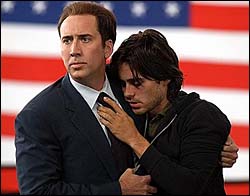
Normally, I dislike movies that are as down as this but somehow, and I’m not sure how, director Gore Verbinski and writer Steve Conrad (not to mention Nicolas Cage in what may be his best performance) have made this an utterly compelling film.

I know Dave Spritz (Cage’s character). I sometimes fear I am Dave Spritz. As Roger Ebert points out, while this is a comedy of sorts (a satire), it’s really a tragedy. That is the arc. However, part of what makes this movie so interesting is the way the script plays with that.

In terms of how the final scenes are presented, such as the style, it feels like a kind of happy ending, almost a Hollywood ending. But once you think about what the ending is, what it means … well, then you see what Ebert means about the story being about a hero who falls from “a low height.”

It is a fall, despite the tone of the ending (which is part of the satirical element).

I suppose what I most like about the film is that it is a story of a man who is average at best (or, as the character Spritz himself puts it, “I’m fast food”) struggling in our contemporary world, one that is predicated on him being exactly that – average at best, fast food.

I should mention the other brilliant performance in the film, which is Michael Caine as Spritz’s father Robert. Caine manages to get most of the best lines and shares the movie's best scene with Cage.

And despite the humour in the film (which is really not that funny as it’s undercut, fittingly I think, by the music which continually reminds us of what we’re seeing), it is Caine’s character who really gets at what the movie’s informing theme is when he refers to “this shit life.”

The movie is about coming to terms with that, rather a dubious accomplishment as the movie suggests.

Tag: , , , , , ,

February 12, 2006

What I’ve been watching

My posts seems to be very light on content and not terribly frequent these days. So it goes when life insists you pay the rent. But …

Earlier in the week I picked up (and watched) Breakfast at Tiffany’s – Anniversary Edition. While I’ve always liked the movie, it does have a few problems (like Mickey Rooney’s Japanese guy – not a great idea).

But you have to love Audrey Hepburn in this. And the quality of this disc seems pretty good so, given the price, it’s well worth picking this up.

I also watched A Very Long Engagement, which I personally like a lot more than Amelie, also directed by Jean-Pierre Jeunet and starring Audrey Tautou. Unfortunately, I’m not sure I can articulate why I liked it so much. I’ll try to figure it out.

Let’s see … what else? Well, Hustle & Flow was pretty darned good. I also watched The Gift (from 2000), which I liked quite a bit (I like most things with Cate Blanchett).

Also watched Educating Rita (1983) – a pretty film good though not as good as I remember. (I saw it way back when it came out and absolutely loved it. Time has taken some of the glow off for me, though.)

Finally … I’ve watched Cameron Crowe’s Elizabethtown – actually, I watched it twice. Although hugely flawed, I really liked it a lot – probably because it’s a type of movie I’m drawn to and I like Kirsten Dunst. But I do think the movie overcomes its flaws and works to a degree.

While it appears I've not been watching older movies recently (and I haven't), this should change soon. In the "on-deck circle"? Chaplin's City Lights (1931). And Ford's Young Mr. Lincoln (1939). So I'm excited.

Tag: , , ,

January 28, 2006

I'm still watching older movies

It appears from my last few posts that all I'm watching is new movies. But actually, that's not quite the case. It's true I go in phases where I go for a period focused on older films then a new phase of newer ones, but the last few posts are a bit misleading. They appear to be all recent releases. But ...

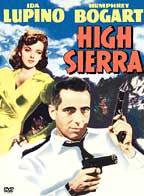
One of the best of the discs I've watched recently was High Sierra (1940) ... that's the one that kind of got Humphrey Bogart going and it's absolutely wonderful. I don't know if I'll get around to writing about it, but just so you know (if you don't already), it's a bit of a noir piece.

I'm also in the process of working my way through Sam Peckinpah's the Legendary Westerns, a collection of four of his films of which I've so far watched Ride the High Country and The Ballad of Cable Hogue.

Anyway ... the point is, I am watching a good variety of new and old, I just haven't had the time to post about them.

But I'll try! I'll try!

Tags: , , ,

January 22, 2006

My top DVDs of last year revised slightly

A while back I posted My Top Ten DVDs of 2005 … but I was rushed when I did it and hadn’t really given it the thought I should have. And there was one glaring omission. And that, of course, was Serenity.

How could I have missed that?

It’s easily my favourite film of last year. In fact, I spent Christmas watching Serenity and, afterwards, watching the Firefly series.

(Yes, I was compelled to pick up that DVD after seing the movie.)

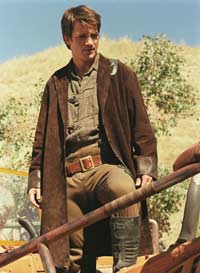
What is it about Serenity that makes it so good? Well, like a really good TV series it yanks you into its characters and makes you want to know what’s happening to them. Also, despite being science fiction of sorts, it’s really a western – with all the clichés and romanticism and mythology that that implies.

It has action but, unlike some of the more idiotic action films, it knows that it’s most riveting element is its characters and so, even during action sequences, the film pauses for a line or two of dialogue that reinforces who the characters are and what their motivations are. It’s not just guys banging each other over the head and some razzle dazzle cinematic tricks.

More than anything else, though, it is just fun to watch. I’ve seen it three times now and I’m surprised that I’m not yet tired of it. I will likely watch it again soon.

I think it wins hands down as my favourite film of last year. I think it's the science fiction film I was always hoping the various Star Trek films might be.

Tag: , ,

January 19, 2006

Lord of War - the lecture

Quickly ... watched Lord of War last night and I'm still trying to determine what I thought of it. Actually, I do know ... but I want to watch it again as my mood may have influenced my perception.

But here are a few thoughts ... the first thing that struck me was how dark the DVD is. I think they went overboard in the transfer with the contrast or whatever the tech way to describe it is called. Scenes are supposed to be dark but this seemed excessive to me. Some shots were silhouettes, but so were some shots that weren't supposed to be. At least, that's how it struck me.

I wished they had packaged the two disc set in something other than lame-ass cardboard.

The movie ... I was a bit put off because, as I've mentioned in other places, I'm not a big fan of films that use voice over narration. And this film is almost all voice over narration. So to a large degree my sense was of a story being told as opposed to being shown.

The film is very earnest about it's subject matter (the sale of guns). And while I am sympathetic to the point of view, it felt like listening to an impassioned speech. It felt like being lectured to.

As someone on another site describe it (can't remember which one), it's a bit like an extended public service announcement.

I'll give the film another chance, as I said. But I think generally I was disappointed. I believe some of the good reviews the film received were based on being told what we want to hear, rather than seeing a good story on film.

Tag: , ,

January 11, 2006

The Constant Gardener - good but some reservations

I orginally posted this as a comment on DVD Town (to their review of The Constant Gardener). But I thought I'd put it up here ... for what it's worth:

I just watched the film and I'm a little ... uncertain what I think. I liked the it, i'm just not sure how much I liked it.

I've read the novel and wish I hadn't - I'd prefer to see a film without preconceptions. Still, I suspect having read the novel doesn't affect the viewing all that much. The visual style, however, does.

While I had no problem in the second half of the film, once it had decided to settle on Ralph Fiennes' character, in the first half I found the documentary style (for lack of a better word) simply compounded what was already a confusing exposition.

So I'm not so sure I give this a big stylistic thumbs up. I think it might have played better with a more conventional style. I think in the first half there is simply too much information to convey for this kind of approach. I think the style, as a style, is fine but requires a more simple story to work effectively.

As you've mentioned, both in the movie and the book, the relationship is easily the most compelling element of the story. The drug company thing ... well, that's the usual movie stuff. But the relationship - now that was compelling.

But I'll have to watch it again before I decide.

Tag: , ,

January 8, 2006

My Top Ten DVDs of 2005

Yes, I'm a little slow getting this up but better late than never.

As mentioned in previous years, more than anything else this reflects what I watched - it's as much gut based as it is critical. Maybe more so. I've watched all of these several times since getting them simply because I liked them. In some cases it's based primarily on the quality of the film though the quality of the DVD and it's overall packaging is often a factor too.

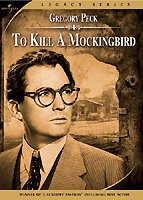
Which is why I think to To Kill A Mockingbird may have been the best DVD release of 2005. Quite apart from the merits of the film, the DVD and its packaging were superb as well. (On the other hand, The Miracle of Morgan's Creek is based strictly on the film - the DVD is a pretty good transfer but nothing to write home about in terms of the features or packaging, which are all but non-existent.) And in some cases, I put collections in as opposed to single movies because - well, they were great collections.

Again, in no particular order, my top ten DVDs of 2005:

- Bringing Up Baby (1938)
- Finding Neverland (2004)
- Errol Flynn: The Signature Collection (1935 - 1941)
- A Love Song for Bobby Long (2004)
- The Life Aquatic with Steve Zissou (2004)
- Million Dollar Baby (2004)
- The Complete Thin Man Collection (1934 - 1947)
- Crash (2004)
- To Kill A Mockingbird - Special Edition (Legacy Series) (1962)
- The Miracle of Morgan's Creek (1944)

Tag: , , , ,

January 6, 2006

Still here and watching movies

Yes, I've been M.I.A. for quite some time, though I've been watching movies. A LOT of movies.

For instance, tonight I watched The Skeleton Key, a movie that was okay - not great - until it got to the end where it sucked in a very major way. Predictable ending - the kind where some idiot decides he or she will be clever and do a Twilight Zone kind of end. That means (bit of a spoiler here) that the good guys come out badly and the bad guys win.

It's the kind of ending you dream up when you're 16 and think you're brilliant. I found it a very disappointing end to a movie that, up to that point, had been a parade of cliches fairly well handled.

By the way ... who was the genius who hired a great actor like John Hurt to play a part where he does nothing but groan and look pathetic? A freaking monkey could have played that. If you're going to hire good actors, give them something to do for heaven's sake.

The movie isn't as bad as I make it sound. But the more I think about it the more annoyed I get at its wasted potential.

On the other hand ... should you want to see a good movie, one of the many films I've seen recently is This Gun For Hire (1942) with Veronica Lake (looking fabulous), Robert Preston and Alan Ladd as the somewhat tortured Raven, a somewhat troubled killer. A great noir piece.

I've seen many other films recently, and hope to get to them eventually. For example, Two for the Road (1967) was pretty good (Audrey Hepburn and Albert Finney), as was Leave Her To Heaven (1950), in a bit of a soap opera-ish way (Gene Tierney, Cornel Wilde and Jeanne Crain).

And my favourite over the holiday period, the TV series Firefly and the subsequent movie Serenity. They were fabulous!

Tag: , , , ,

November 26, 2005

Lost at sea - Hitchocock's Lifeboat

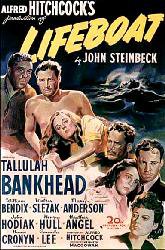
I haven't been feeling well the last few days and thus haven't had an inclination to do much of anything, but ... I did manage to watch a film or two, including Alfred Hitchcock's Lifeboat (1944).

It was pretty good. As with most Hitchcock, he sets himself a challenge - in this case, shooting an entire movie within the confines of a lifeboat. From the opening shot of Tallulah Bankhead in her fur coat, with her camera sitting in the boat, right to the end, everything goes on in the boat.

You would think the film would get claustrophopic, but it doesn't. In fact, the scenes move quite quickly, and compellingly.

The film works partly because of the script (a story by John Steinbeck, screenplay by Jo Swerling). Relationships form, shift and develop through the movie. And it's set on the Atlantic during World War II (when it was also shot), so part of the drama comes from the fact that one of the passengers on the lifeboat is the captain of the German boat that sank the liner the rest of the passengers had been on.

In a way, it's a standard dramatic situation - take a disparate group of people and throw them together, here in a tightly enclosed space none of them can flee.

In a way, Hitchcock has made an entire film using a single set, much as he did with Rope though his approach is very different.

Regardless of what he does, the end result is a very entertaining movie.

Tag: , , , , ,

November 22, 2005

King Kong on deck

I can't say I'm overly excited about Peter Jackson's remake of King Kong - but that may change once it's out. As a general rule, I don't like remakes.

I am excited, however, about the Amazon package that arrived today with my King Kong Collection. This includes the special edition two disc set of the original King Kong (1933), the sequel Son of Kong, and Mighty Joe Young (1949). Also arriving in the Amazon box was a completely unrelated movie, Operation Petticoat (1959), which starred Cary Grant and Tony Curtis.

Jackson's King Kong may be the exception - a good remake. But until I see it and can judge, I'm more than happy to have the original. There's a certain charm to those black and white movies.

And really, there is no remaking Fay Wray, the girl from Cardston, Alberta.

Tag: , , , , ,

November 20, 2005

Hitchcock's Dial M for Murder quite slow

I see most movies by myself - perhaps because I watch so many, and so many during the week. But seeing movies with others, especially with people who like movies but are not aficionados, definitely is insightful.

After dinner last night, three of us sat down to watch Alfred Hitchcock's Dial M for Murder (1954).

Well, Liz fell asleep. Mind you, she was pretty whipped. Still, tired or not, someone falling asleep, especially early in a film, is not a good sign.

As we watched, I felt it dragged quite a bit, at least in the first half, due to all the tedious exposition - especially the scene where Ray Milland goes on with no apparent end essentially establishing the set up for the second half of the film. That's the scene where he explains to Anthony Dawson, who is being blackmailed into killing Grace Kelly, the scheme.

Gord, during all of this, commented on how bad the script was. I think he was responding to how extremely long the scene is, and how it was all dialogue. Sure, people moved around, there was some camera movement and a few cuts, but you can see how it is based on a play and that means people just talking, explaining. Hitchcock does try to make it visual but still, it is all dialogue. For an audience of today, the scene is quite deadly.

It's a weakness of the murder mystery - they inevitably have to establish story elements - characters and plot points - which usually means exposition. I find this in most of the old Columbo mysteries from TV. The first 20 or 30 minutes are boring because that is where they establish the crime and the characters. It isn't till Columbo shows up that things get interesting.

So it is in Dial M for Murder. It isn't engaging until the murder attempt is made, almost halfway through the film.

In the end, Dial M is worth seeing - there are some good elements. But it's also dated somewhat and, partly due to genre and partly due to its being based on a play, it is tedious for a large part of the film.

Still, watching Grace Kelly is, as always, delightful.

Tag: , , , , ,

November 17, 2005

Another of my recurring Cary Grant phases

I seem to be going through one of my recurring Cary Grant phases. I finished reading Cary Grant by Marc Eliot, and it was certainly interesting. (I made a brief post about on my other blog, Crazy Ass Planet.)

Of course, since I was reading about Grant, I had to watch (or rewatch) some of his movies. That meant The Philadelphia Story, The Awful Truth, North by Northwest and Brining Up Baby. But it also meant picking up a few of his other movies, ones I either hadn't seen or didn't remember.

So I also watched People Will Talk (1951) with Jeanne Crain and directed by Joseph L. Mankiewicz. Not a bad movie, but not great either. It's a little too earnest and Cary Grant is just a little too ... posed? There's very little range in his character. He's just a handsome good guy.

The other film I watched was The Bachelor and the Bobby-Soxer with Myrna Loy and Shirley Temple, directed by Irving Reis. I liked this one much more, though once again it's far from great. But, despite a pretty silly storyline, it's quite funny - largely because Grant plays comedy so well. And it is well-directed in a functional way. Grant seems much more comfortable and assured in this film than in People Willl Talk and I think it's because he was much more comfortable playing comedy, poking fun at himself, than in drama (unless he was being directed by Hitchcock).

Speaking of whom, the next on my list is Suspicion. I haven't seen that one for a while.

Tag: , , ,

November 13, 2005

For your viewing pleasure, Gina Lollobrigida

I don't know why, but I'm getting a lot people dropping off here looking for Gina Lollobrigida. I, too, am very fond of Gina.

I just don't know why people are looking for her here.

Actually, I do. Some time back I discovered, while searching for something else, a Gina Lollobrigida link came up - very high in the listing of results. I thought that was odd, posted about it, and used a Gina image in the post.

Now I'm one of the top, if not the top result when you search for Gina Lollobrigida images on Google.

Searchers must be very disappointed. This is not the place to be looking for Gina Lollobrigida information or images. It's just a blog about movies by a guy who likes Gina Lollobrigida, amongst many other actors. Ah well!

Tag: , ,